Tuesday, December 04, 2012

Lux Aeterna: Premiere

In January 2011 I wrote a short piece of a capella music for men's chorus, "Lux Aeterna," on the Latin text from the Requiem Mass.

It's a favorite text of mine, since, although I am post-Christian, there are many areas of spirituality that I find to be universal and eternal. The aspects of the existing organized religions that I find to be congenial and meaningful are those that speak of unconditional love, acceptance, compassion, universal siblinghood (if you will), and holiness.

To define the essential core of my personal spiritual practice more truly than I ever have before, my personal religion is that of the Light. I follow the Light. I may have been born in the darkness, but I work for the Light.

On one level, that's just another label, ultimately misleading because incapable of fully encapsulating what I mean into one word that functions as a label. What do I mean by "the Light"? So much more than I can put into words. Which is one reason I periodically choose to set sacred texts about the Light to music. Music goes deeper than words.

This isn't by any means the first piece I've written about the Light that was written during the dark days of winter, near the winter solstice, or soon after. Nor is it likely to be the last.

The Light is a recurring theme in much of my art-making, including my composed music, and I return to it again and again.

Indeed, when I operate as a fine art landscape photographer, every image made in the camera is made with light, and most are, if you look past the obvious subject of the photo, about the Light. I photograph the quality of the ever-changing light, as one my primary subject matters.

Here is the Latin text of "Lux Aeterna," followed by an English translation. (My own rendition from the Latin, based on a handful of other translations.) It is a text that begins and ends with eternal light:

Lux aeterna luceat eis, Domine,
cum sanctis tuis in aeternum,
quia pius es.
Requiem aeternam dona eis, Domine,
et lux perpetua luceat eis.


Eternal light shine on them, Lord,
with your saints in eternity,
for you are merciful.
Grant them eternal rest, Lord,
and perpetual light shine on them.

To say that I serve the Light doesn't mean that I deny the darkness, without or within. If anything, I know the darkness so well that I have chosen to serve the Light. (There are a lot of personal biographical and spiritual stories about how I was led to that choice, but those are irrelevant here.)

When I am writing the music to an existing sacred text, the words lead me towards how to depict them in music. I could go into a detailed analysis of my music and how it relates to the text, but in truth I don't think that matters. What matters is that the music have the emotional impact and depth found in the text.

Here's a sample of the music, from the middle of the score, to give you a sense of the setting and musical style:
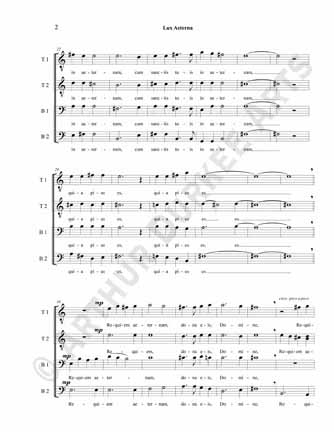

(Click on image for larger version.)

In just a few days, on December 8 & 9, 2012, "Lux Aeterna" will be premiered by Perfect Harmony Men's Chorus, in Madison, WI, as part of their 2012 winter concert series. The concert this year is themed as Warm Wishes from Wisconsin, and consists this year of mostly popular songs in gorgeous choral arrangements, a few novelties that will make you laugh out loud, and a few story-songs and carols that are powerful and moving, including some of the beautiful Alfred Burt carols. "Lux Aeterna" is the only sacred choral work on this year's winter concert.

I am pleased and proud to have my music sung by this group of excellent singers. I am doubly pleased that so many chorus members have told me that they like this piece a great deal. It is a piece in a fairly modern, somewhat challenging harmonic style (remember what I said earlier about depicting the text in its emotional impact), and they have worked in rehearsal, and that hard work has paid off. We will be premiering "Lux Aeterna" in a resonant performance space well suited to choral music, that will maximize the music's effect, so I look forward to hearing it there.

May the Light preserve and protect you, and lead you home!

Labels: , , , , ,

Thursday, October 18, 2012

Heartlands CD


News flash!

The Heartlands CD is finished and available for purchase. (Assuming you haven't already pre-ordered it.) As the composer and lyricist of this work, I am incredibly pleased at the completion of this CD release project. At some point, I will have more to write about it, and more to announce. For now, though, I just want to announce the news of the release itself.

You can acquire the Heartlands CD via the Perfect Harmony Men's Chorus website.


I also did the illustration and typography, layout and design for the CD and booklet. Here's the track listing the 19 pieces that make up Heartlands.


So, the completion of the major musical composition project of my life for the last year or so. I am incredibly pleased at the completion of this project. I'm also rather exhausted, and I've had some post-partum depression since our last concert performance of this music. But what matters is that this is only the beginning of the life of this CD. And that is the continuance as well as the beginning of the next phase of life for this music, for Heartlands. I hope to have more performances of this music, and also to be given the opportunity to write more in future.

Labels: , , , ,

Monday, August 20, 2012

GALA in Denver: A Personal Overview

(Images from the Denver Performing Arts Center, Denver, CO, July 2012)


In early July I was in Denver for five days at the GALA Festival of choral music, which happens every four years.


This was my second GALA Festival, my first one being in Miami in 2008. The Festival featured over 100 choruses of every conceivable configuration performing for each other and the public. There were special concerts, morning seminars both artistic and business-oriented, huge mass choral singalongs, and more. Over 6000 delegates attended, including singers, artistic directors, members of boards of directors, and more.


I attended and performed at GALA as a member of Perfect Harmony Men's Chorus of Madison. We performed our set in combination with City of Festivals Men's Chorus of Milwaukee.


I also attended as a GALA composer: someone who had written music that was being premiered at the GALA Festival. In 2011 I was commissioned to write a major new work for Perfect Harmony Men's Chorus, based on the lives and stories of the men in the Chorus. I interviewed many men, and gathered many emails and poems and other materials given to me by the members of the Chorus, then made them into poetry and music, completing a new work entitled Heartlands, in 19 movements in various moods and styles. This was a major commission for me, and work I was pleased to do. We premiered the work in June 2012 in concerts in Madison and Milwaukee, then re-premiered 7 songs from the work at GALA in Denver.


It was a privilege and an honor to have my music performed at GALA in Denver. "Heartlands" puts me among the ranks of composers who have been commissioned by choruses and had their works performed at GALA Festivals, which honors me. An important aspect of the entire GALA movement has been to commission new music: when the movement began in the early 1980s, hardly any music specific to LGBT choruses existed, those stories had not yet been told in music. Now many classics have been written, and performed by many choruses worldwide again and again.


The LGBT chorus movement has been about both affirmation and ambassadorship. Many choruses share similar mission statements, alike in intent if not in exact wording. That mission often reduces to: reaching out to make the world a better place through song. It involves education about LGBT social issues and lifestyles. It presents the movements for equality—and against bullying and other forms of oppression—in their best light, in an almost-unified message of validation and resistance.


(Downtown Denver at night)

The social-justice aspect of GALA Choruses is at times more dominant than the musical aspect. Personally, I like it best when both aspects are in balance. I think the social-justice aspect is best served by being cast as memorable and enduring art. For the same reasons that political poetry often has a short shelf-life, music about a social issue can be topical but not long-lived unless it finds something universal within the personal, and touches an enduring chord within both performers and listeners. Not all GALA Chorus music succeeds in the long haul; but there is a lot of new music still being written, and some of it will most definitely endure.


Meanwhile, many of the social-justice issues surrounding LGBT life remain unresolved, so much of the music will remain relevant until AIDS has been cured, until kids stop committing suicide (at triple the usual rate among teenagers) for having been bullied for being gay, until marriage equality has been achieved, until all states in the union no longer allow businesses to fire you or landlords to deny you a lease, just because you are who you are. In other words, till being different is no longer stigmatized, and all aspects of personal diversity become No Big Deal to the mainstream general culture—which is what the US Constitution promises all of us, at its core.


Heartlands was written to tell the stories of men growing up and living as gay people in the Midwestern heartlands, between the Great Lakes and the Great Prairie. The words and music evolved from many interviews done with the members of Perfect Harmony, and from writings and stories submitted during a process of gathering material. It was my job to then take those stories and interviews and turn them into poetry, then set those words to music. Often the stories themselves gave me a clue as to what style of words and music should be used to tell them: many stories had threads in common with other stories, leading to choral pieces that were many voices singing in unison or in parallel; other stories were distinct and unique, and led to writing either solo songs, or were set as movements for soloists with chorus. The range and style of music and mood across all 19 movements was diverse, and intended to be.


What that led to, at GALA in Denver, was a response that I had hoped for: we were one of the few performances at Festival that included light and dark, anger and sorrow as well as joy and affirmation. In fact, comments made their way back to us after our performance that our presentation stood out in its authenticity, for being "real" about how life really is, in all its complexity. Heartlands also stood out for being genuinely emotional because so many other choruses chose, this Festival, to do sets that revolved presentations of LGBT life as seen in current popular media, many performances notably modeled on or in imitation of the current television program Glee.


To be clear where I stand, and with no intent to provoke anything but thoughtful discussion: Glee has many charming aspects, not least of which is that it presents a lot of music performances on any given episode. However, Glee also presents a fantasy of schoolyard acceptance, represents culture as superficially as most contemporary pop music entertainment has often done, and in the end doesn't really stick to the ribs. At GALA Festival 2012 in Denver, the influence of Glee was perhaps too prevalent, as many GALA choruses performed sets direct from the TV show. This produced mixed results. Some choruses performed their Glee-inspired sets with such gusto, such enthusiasm, such vigor and joyfulness, that the audience was totally won over. Other Glee-influenced sets were less impressive, and less enjoyable. A lot of what made a difference was level of performance, and style of presentation: giving to whatever you're singing all of your heart and soul will always help you connect with your audience, and simultaneously giving a technically-excellent performance will only enhance that.


In my personal opinion, the influence of Glee on this GALA Festival was strong, perhaps too prevalent, and not always a good idea. On the other hand, some of the feedback we received about our performance of part of Heartlands was that it stood out all the more because of the context in which it was presented. I think some GALA delegates thought of our set as even more authentic and stand-out because we did a set so very different from many of the Glee-dominated sets. LGBT life out there in the real world is not all unicorns and puppies, folks, and the movements of Heartlands that we presented at GALA Festival made that clear.


There have been numerous similar commissions written for GALA choruses before—but not from a uniquely Midwestern, cornfield-and-small-town perspective. Most similar GALA works, made up from the stories of members of the choruses who commissioned the work, have been made from choruses that come from dominantly urban, coastal areas. I have essayed before that one of the most significant divides within LGBT culture is the urban-rural divide, which I believe is actually a greater divide than many others that create sub-cultures within overall LGBT culture. Heartlands reflects this, with many segments of the work focusing on what it's like to grow up and live as LGBT within small rural towns, on the farm, in those smaller places between the coastal regions of the USA that many people on those coasts dismiss as important, as the "flyover zone." Even within mainstream LGBT culture, which is mainly an urban (or urban ghetto) or suburban culture by its own estimation, the stories of rural gays and lesbians are often marginalized as outsider subcultures. So far as we knew when we began the writing of Heartlands, many of these kinds of stories of LGBT life the rural Midwest had never before been told in song, nor told at GALA Festival, except perhaps in small bits, in passing. Heartlands represents the first major choral work intended to fill in that gap.


As I said, for myself performing my own music at GALA Festival 2012 was a dream come true. I am now a "GALA composer." Perfect Harmony Men's Chorus gained status at this GALA Festival by being one of the small number choruses to present a full set of all-new, all-commissioned music—which put them among the ranks of much larger, more famous choruses such as San Francisco, Portland, Twin Cities and others with much larger memberships and budgets, who regularly commission new music. That our performance set was so very well-received put me on cloud nine for weeks afterwards. (Since I got home from GALA I admit to personally experiencing a difficult level of post-GALA, post-partum depression. I can hardly wait till next Festival, or the next new music commission I am asked to do.) My ambition is to do it all over again: write new music for other GALA choruses, to receive other performances in whole or in part of Heartlands, perhaps by other choruses, and to make this my future career. Nothing would please me more than to be once again a GALA composer.


There are other aspects of my experience at GALA Festival in Denver that I am still integrating, still thinking about, still exploring in my mind. I expect that process to percolate on for awhile. And I'm in no hurry to analyze or conclude. Meanwhile, life goes on, I continue to write new music, new songs, new words, and expect that to continue. Perfect Harmony will performing a short piece of mine this upcoming winter concert, a setting of the "Lux Aeterna." And being at GALA Festival inspired me to write a piece in commemoration of the life and work of Harvey Milk, using his own words as text, "You Gotta Give 'Em Hope." In my life, creative forward momentum continues on, and I hope it continues to do so for a long, long time. So Mote It Be!

Labels: , , , , ,

Saturday, June 02, 2012

Heartlands: Some Publicity Before the Premiere

Perfect Harmony Men's Chorus Artistic Director Ken Forney was interviewed about "Heartlands" on WORT-FM Madison, WI, the community radio station in Madison. Mr. Forney was interviewed on the program "Queery," Madison's first community radio show on local and regional QLGBT issues.

You can go to the WORT-FM archives to listen to the show here, or download the show as an MP3 podcast here.

(Full disclosure: I was a volunteer radio programmer on WORT-FM myself for 7 or 8 years, in the 1990s. I did the Sunday night avant-garde new music show, 11pm till 2am. I had a major market share for that show while ran it; happily a version of the show is still on the air. Consequently I'm pleased that my community radio alma mater is taking an interest in my music.)


Also, the Wisconsin Gazette online magazine, which provides monthly coverage of Wisconsin's LGBT community, has interviewed myself and Ken Forney, and produced an article about the premiere of "Heartlands."

You can view or download the May 31, 2012, issue of the Wisconsin Gazette here. See page 23 for the article on "Heartlands," and page 53 for an advertisement for the concert premieres.

Labels: , , ,

Wednesday, May 23, 2012

Canticles for Robert Espindola

In the past few weeks, my favorite aunt and two friends have all been found to have cancer, some quite virulently, and all three are dealing with cancer in the neck and throat areas of the body. I don't know what it means, if indeed it means anything; I just note the compelling synchronicity. I wish all of them the best during their medical journeys, I will be keeping good thoughts for them, keeping them in my prayers, and hoping for the best possible outcomes in every case.

When I gave up my own life (and faltering corporate design career) to move back in with my father to be his full-time live-in caregiver following his diagnosis with colon cancer, caring for him for the last year of his life; when I then took care of my mother till she died less than a year later of complications brought on by Alzheimer's; and when, in between my parents' deaths, I was diagnosed with a serious chronic illness that had already decimated my health and well-being for probably two decades before it was recognized; and when, while still ill and weak with illness, I had to close down my parents' house, buy my own, and try to live my own life again; and, soon after, when my own chronic illness worsened to a severity that almost killed me, caused my health to be utterly destroyed, and which led to a journey of multiple surgeries to first cure my chronic illness, and eventually (I still hope) reverse some of the damages done to me—when all of these dovetailing journeys of cancer, death, multiple hospital and clinic and doctor's visits, when all of these things happened to my family and in my own life, I learned many lessons about endurance, about survival, about refusing to give in to illness and death, and about just getting through the bad days, nothing more, nothing less. When I had the first surgery, last year, I was promised my health would eventually recover, and I would get my life back. That still hasn't happened, not yet. I am still on my own medical journey. I'm nowhere near finished with my journey. I'm not "all over it" yet. I know the needles, the smells of medical care, the scars, the radiation burns, the weakness, the suffering, both personally, and through watching my loved ones go through it, and I know these only too well.

I know only too well that some journeys don't end, you just learn to be a traveler. You do what you have to. You go on. You get through it, however best you can. One day at a time.

So I feel a huge swell of empathy for my aunt and friends on their current journeys, both minor and major. The echoes in my own life of recent years are too loud to articulate—except in art, poetry, music—and sometimes all I can do is pray, meditate, hope, wish the best for those I love. I make art about all this as a way of coping with it. I write poems about surgery as a way of dealing with its aftermath. I make visual art directly involving the numerous blood transfusions and surgery as a way of owning it. I wrote numerous poems about my father's chemotherapy and treatments as a way of not going crazy with being his live-in caregiver. And this all feeds into my music, too.

It can make you feel utterly helpless to do anything, when people you care about are suffering, and you can't wave a magic wand and just "fix" it—at which point you have to learn even deeper lessons about acceptance of what is, just simple acceptance with clear vision and no filters blocking it, and go on from there. Life will go on, even after we die. It's what we do with our lives, with our brief time in eternity, right here, right now, that matters. Start where you are. The journey can begin in no other place.

And so, after hearing about Robert Espindola's probably major, even radical cancer surgery journey to come, I was moved to write the poem below. As it happens, it was one of those poems that came to me at white heat, with no warning, that wrote itself in the space of an hour, and which needed little revision. I will let it stand.

It's terribly presumptuous of me, I know.

Robert and I know each other only as acquaintances who meet on occasion. Each time we have spent time together, we have gotten along well, and I for one have always enjoyed his company, but I'm hardly a close friend in the inner circle. Yet he, as a poet and lyricist, and his partner, Robert Seeley, as a composer, have been a tremendous influence on me, inspiring me to throw my hat in the ring to write new music for LGBT choral groups. Last year I was commissioned to do just that, and that new music will be performed less than a month from now. "The Roberts," as we who have worked with them, and know them familiarly, call them with affection, have been responsible for creating some great new works for LGBT choruses, with many commissions, such as Metamorphosis and Naked Man, that are now standard repertoire in GALA choral circles. Personally, I would be content to follow in their remarkable footsteps, write lots of music for GALA choruses, and enjoy every moment of doing so. That's how they have been an example to me, and it's in the spirit of gratitude for their gifts to all of us, and hope for Robert's medical journey, that I wrote this poem.

It's presumptuous of me to write this poem, equally so to share it. Yet I say: we're all survivors. Sometimes we all need to vent, to scream, to get the horror and rage and anger out of our bodies. Even if we are voiceless because cancer has taken our very ability to speak, our throats, our lungs (as my favorite uncle's lungs were taken, also by cancer), we can still cry on each others' shoulders. Be well, regardless. No matter what.


Canticles for Robert

i.

Orpheus of cancer
a journey to the underworld and back
of needles, disinfectant, hospital stink
sterile gauze, and protons flung
at tissue till it melts

Melts into airy dream
and feathers fall as though
unleashed by the magus
back into elemental formlessness
where books are drowned

Wings quiver on the lips of cliffs
where voices cascade into seas
much broader than we imagined
we in our little worlds
that had given up singing

All a poet can do today is warm
to find a fire in words that conjure worlds
you pull the fabric to the mirror
that concealed what could be seen
and make of it a mystery

Voices melt as throats row into heat
a canvas made of charism
a proteus of doubt
some needle made of dissonance
that melts a lover's hearth

ii.

My father melted into silence
further down this same journey
you now find yourself enroute
I too have known the needle jab
and copper stink of blood
the chemical fear and torment
of the unknown and unremarked

I am no great shepherd of
the matters of the world
I can only wish for you my dying father's
behest, which came to me an hour
after he had passed: he smothered me
in joy and laughed that it all
was so much better than he'd dreamed

but still myself walking the world with you
still scarred and scared and myself melting
still on an unfinished journey
where at last I've found my voice—

my perfect voice of love and melting
anger not irresolute
nor uncomplicated by a quest
not unlike yours, to make the world
a finer place through song—

my central wish for you is: more life
more life, much more, and dignity

take heart to know, no matter what:
mage, your song will remain heard
in the infinite ears of ocean, of desert
fragrant storm that ripples
out to every melody and merges:
that song itself can give its voice
that breath itself sustain us

Labels: , , , , , , ,

Monday, May 21, 2012

Heartlands: A round on "When We Sing"

In preparation for the GALA choral Festival 2012 in Denver, an email went out to composers who have been involved with GALA, or who have been commissioned in the past by GALA choruses, artistic directors, and other interested composers. At every Festival there are evening concert blocks, with volunteer mass choruses made up of the members and delegates. There are always sing-along moments included in these events, and during the opening and closing ceremonies—this is a choral festival, after all, so sing-alongs are likely.

This year, there was a new idea, and this is where the composers come in, and I quote:

Why not create a body of simple, songs that could be taught on the spot in a sing-along setting and then taken out into the world by our choruses?

As a GALA friend and composer, you are invited to create a short round/canon or chant for GALA Festival 2012. All songs will be taught from stage by rote, but delegates will be able to download the complete collection of songs to take home to their own chorus to be shared, copied, taught, sung and performed without restriction all over the world. We want to get this music OUT there!


The call was for rounds, canons, chants, simple enough to be taught by rote from the stage in a few minutes, should include multiple voice parts not restricted to any particular voice so that men, women, and others could all join in, and be unaccompanied (a capella) vocal music.

So I joined in, and wrote two short pieces, a round and a canon, and sent them off. Hopefully they'll be part of the Festival mix. If the response is overwhelming, there won't be time to do all the pieces submitted, so they'll pick and choose.

But I thought this would be a great way to both join in, as a composer, and present my work to the GALA members. After all, it would be nice to be commissioned again to write music for a GALA chorus, as I was last year. I wrote "Heartlands" on commission, both words and music, and selected movements will be performed at the 2012 GALA Festival in Denver, in July. Participating in the GALA round/canon call would be one good way to get my music known by others, and also be a bit of free advertising for "Heartlands."

So while I wrote one completely new piece, I also took a refrain from the finale movement of "Heartlands," titled "When We Sing," and arranged it into a two-part a capella round.

Here's the music for it:


(Click on image for larger version.)

One group of singers will read through the first line, then go on to the second line while another group of singers does the first line. You go around and around till deciding to stop, which is how rounds are constructed. It's a very old musical form; if you think about it, you know some nursery rhymes and campfire songs in this form, such as "Row Row Row Your Boat." For this piece, I also opened it up to free harmonizing on the repeat, after every group has gone around the form once or twice.

I wrote two pieces in two days for this call for compositions, and sent them off right away. As I said, one was completely new, and this one was taken from "Heartlands." That ties it to the larger work, and hopefully makes connections and gets people interested in the larger work. And in my work as a composer in general. Nothing would make me happier than to have to do it all again.

Writing in short forms can be challenging. It's like writing haiku: you have to compress as much as possible, to get in as much information as you can into a very small space. Short forms such as rounds are technically challenging, as well, for needing to be circular and layered. You can think of a round as a variety of musical Moebius strip, with the musical line constantly turning back in on itself, each layer interacting with other parts of the music to add up to a larger, synergistic whole. Each line has to be checked against the others for effect, contrast, and similarity. So you end up thinking in circles, as you're writing in circles. Or at least I do.

This was quite a bit of fun. A fun challenge, and a good occasion for which to write a new piece. We'll see what develops next.

Labels: , , , , , ,

Tuesday, April 12, 2011

Process of Writing 4: Lightning

A few days ago, rather than drive home through a fierce thunderstorm after chorus rehearsal in Madison, I went with some of the guys to a local all-night restaurant for awhile. One example of a restaurant chain I often frequent, but don't feel like giving free advertising to by naming it here, it's one I know I can reliably find gluten-free food at. The night was windy, the moon was high in the sky, and off to the east and south a bank of restless clouds was continuously and relentlessly lit from within by lightning flashes. I would have to drive into that, if I left right away. So I spent a good hour or hour and a half at the restaurant with the guys. We ate, we chatted, we laughed, we told jokes, we told stories. It was a good night.

By the end of our gathering, only three of us left after the others had gone, we evolved a discussion about what it's like to live as a gay man in the Upper Midwest, and other aspects of personal story that lie at the root of the new music commission I am undertaking for the chorus. It was a very good discussion, and some real insights and terrific anecdotes came forward. Meanwhile, throughout our talk, the restaurant's music system was playing 50s and 60s novelty and nostalgia pop songs; songs I hadn't heard in a long time, but which seemed apt for our walks down memory lane. Those songs lingered in the back of my mind throughout our conversation.

When I finally left to drive home, I was tired but content with the day. I had indeed given the storm enough time to pass by, and didn't have to drive through it. The drive home was smooth and relatively easy.

About halfway home, driving down the interstate through the dark, a melody came into my head. Just a simple solo voice line, something mostly positive in feel, with a little bit of poignance to it, but an upbeat tune. I sang it to myself enough times to memorize it, building a longer line, making some chords around it. Ideas for chorus and piano parts to accompany the solo line. Then some words started to appear. A phrase or two, based on one of the life-stories we had been talking about at the restaurant. Just a few words at first, but by the time I got home, I had three short verses of lyric.

I was one
gay son
in our family
Mother disowned me

Then my brother
made two
gay sons
in our family
Mother did not know
what to do. . . .


I prefer subtle rather than blatant rhymes, and I like internal rhymes. Nothing chimes more clumsily on the ear than obvious and predictable end-rhymes, especially when the line is as short as it often needs to be for a good song lyric. Easy end-rhymes make things way too sing-songy, way too easy to make inappropriately ironic. So slant-rhymes, off-rhymes, and internal rhymes are going to appear a lot in the lyrics for the commission—many segments based on the stories I have gathered, as this was—but not more than a few telling end-rhymes. Where you place a rhyme can create dramatic tension, and can itself be a musical effect, like a canon or leitmotif. I also like to use structural rhyme, forms and melodies that recur in separate stanzas without being too blatant. This song has a few rhymes across each stanza, which the listener will take in and interpret as unifying structural points, even if they're not really conscious of the technique of it.

Poetic craft is meant to serve the poetry, not serve itself. Craft is meant to be invisible, or appear easy. It's too tempting to pull out all your poetic chops and over-write song lyrics; just as it can be equally tempting to pull out all one's musical tricks and over-write the music. Most poets who come to songwriting overwrite their lyrics at first, trying to show off every crafty trick they know how to do. Simpler is usually better, though, in song lyrics.

The rest of the drive home, I was singing or humming words and music to this new song in my head, sometimes out loud. When I got home, I went into the house, and immediately sat down and notated in score what had come to me on the drive home. When I was done, I had a complete song sketched out, whose theme and elements were based on some of the stories that the guys had told me earlier, about their own lives. I've written down the essential parts now, enough to shape the overall form of the song, and need only to fill in the bones of the accompaniment. The words and the music came together, this time. A phenomenon I've heard about, from singer-songwriters, but haven't often experienced myself. I added a little bit more tonight, while just sitting and thinking it over.

So, lightning strikes, and you get a full piece out of it. That was a good night's effort.

Labels: , , , , , , ,

Thursday, March 03, 2011

Outside Research, inside Life

Some days, you feel detached enough from your social settings that you participate as though you were an anthropologist undertaking fieldwork: Participating, but with always part of you sitting back and observing, taking notes, observing the natives and the local wildlife, feeling like a non-native, an outsider.

Some people go through their entire lives feeling this way. I've heard more than one writer mention it: Part of them is always taking notes, knowing they'll recycle life into art, even at moments when it might seem ridiculously inappropriate.

But sitting back and observing at one remove, like an anthropological fieldworker isn't necessarily a good way to engage with actually living your life. I would say to more than one writer, or artist, of my acquaintance: While you're living your life, live it to the fullest. Don't keep part of yourself disassociated or abstracted. Live life with full engagement in the present moment. Write about it later. Make art about it later.

It's shocking to me how often that advice falls on deaf ears—often for no better reason than a failure of the imagination, or a lack of trust in one's own memory. Some artists can't stop taking notes because they're afraid they'll miss something—apparently they're stuck in college classroom mode, or grad school mode if you prefer, taking notes in seminar or lecture. For some artists, school does become a habit—but it's a habit that can also be unlearned.

I feel my own best writing is engaged writing, not observational writing. Dive right into the moment, in memory, and write about it. When I sort through photographs, I often find myself able to re-experience somatically what I was thinking and feeling in the moments I made the photograph. And ought of that often emerges a short bit of writing. Photographs as memories, photographs as reminders. Which in the imagination and recreation of memory and experience, become short poems, or prose-poems, or sometimes, longer poems, or poem sequences.

I'm back to not doing much poetry writing again. It's been a slow year for poems, as I mentioned before, except for the surprising poems that emerged this past summer, when I was extremely ill. That series of poems doesn't feel like it ever ended—who knows? another poem can always emerge unexpectedly—but it doesn't feel, at the moment, as though there's any urge to write anymore. I'm back to writing short poems, haiku, and prose-poems, mostly triggered by photographs.

There's no abandonment in this. It's just, as ever, a change of emphasis, a switching of creative channels, an artistic crop rotation. I'm putting my energies where they need to be, for now.

The truth is, I am reserving most of my wordsmithing energies for the new music commission. I'm writing the lyrics as well as the music for this commissioned project, so I'm giving most of my word-oriented creative energy to the lyrics for the songs. I say most, of course, because things always spill over the edges of the container and splash onto other parts of the floor. I've been keeping a notebook of all the fragments, ideas, and structural notes for the commission in a single notebook. I keep it nearby at all times. More than once, when I was on the road last month, ideas for sketches and lyrics would come to me while I was driving, driving along and letting my mind roam over the work, over the landscape.

One of the core themes of the new commission is that Midwestern, heartland culture, really has something unique and special to offer> It has its own tone, style, and pacing. People here in the Upper Midwest do have a culture distinct from the rest of the USA, a certain attitude towards life, a certain way of being—and that will be reflected in all aspects of our lives. The commission is inspired by the living stories of the members of Perfect Harmony Men's Chorus—myself included. And one of the key themes that has emerged from those stories is our about what makes us uniquely Midwestern. It's a little hard to define, or pin down, in prose; and it has both light and dark aspects to it. I'm finding that the best way, so far, to get the lyrics to come forward, is to inhabit the stories, absorb them, become them, and let them re-emerge in my own words. One or two quotes from interviews and writings given to me by Chorus members are going to make it into the finished work; I'm already clear about two or three such fragments. The rest will be passed through my own sensibility—so much so that i feel I am living the stories, which in many cases are not too different from my own anyway, and re-telling them the way an actor does, or a bard does, by living them from the inside.

There's no theoretical framework here, no intellectualizing about what should be said. I do have a rough structural outline for the overall piece. But I don't want to overthink or overintellectualize this music. It needs to emerge via a living process of being inhabited, not merely didactically described. As with poems, I want the lyrics and the music to recreate an experience in the audience. The old dictum "Show, don't tell" is very relevant here. I don't want to create something artificial, an artifice. I want to make something essential, engaging, and gripping.

Stylistically, that means I'm not pushing the musical envelope too hard, so far. I want the music and words to be accessible (without being simple or shallow or clichéd), clear and straightforward (rather than too artificed or overwritten), and universal. GALA choral commissions such as this have an ambassadorial function: they are not only about preaching to the choir, i.e. the LGBT membership of the audience. If only one stranger, or friend, or family member starts to understand the lives led by their gay and lesbian friends and family, because of the music I've presented, I will be joyous and feel richly rewarded.

GALA choruses function as ambassadors for changing peoples' lives, changing peoples' minds, bringing people together, making connections where there may not have been any before. There are two reasons GALA choruses commission so much new music: to build the choral repertoire; and as educational outreach.

The music itself is a kind of activism.

That's how one can change the world, change peoples' minds, open new doors in their experience: by artistically, indirectly communicating with them what it is like to live our lives. Years ago, I was the kind of activist who did march in the streets, participate in protest rallies, and all that. Now I let my art be my quiet, far more compelling, far more subversive, far more viral, form of activism.

And that is about living life from the inside, rather than just intellectually describing it. I once saw an oversized button worn on a shoulder bag by a person met at random on the pedestrian mall along State St. in Madison; the message inscribed thereupon was:

This isn't a rehearsal, this is your life.

So mote it be.

Labels: , , , , ,

Sunday, February 27, 2011

New Music Commission 2012

I'm overdue to announce that I have been commissioned to write a new piece of music: for Perfect Harmony Men's Chorus, of Madison, WI. Perfect Harmony is celebrating its 15th year next season, and the commission is both a celebration of that anniversary, and to be presented at the next GALA Festival in 2012.

I've been involved with PHMC now since 2007, when I joined after my Dad died, to find some social contact with other gay men, and to get back into choral music. I needed both musical and social reconnections, at that time. I am an alumnus of two other GALA choruses, the Twin Cities Gay Men's Chorus, and the San Francisco Gay Men's Chorus. Perfect Harmony is a much smaller chorus than either of those, but it is full of men deeply committed to making music together, and to supporting each other. I knew from my previous experience with other choruses that I would find what I needed, in singing together with other gay men.

TTBB male chorus repertoire (tenor, tenor, baritone, bass) is my preferred choral configuration purely for matters of personal taste. I just like the sound of massed male voices. I sang in the Michigan Men's Glee Club when I was in college, a male chorus of some distinction at that time, and found many rewards there. I fell in love with male choral music, both the social and musical aspects, and for me, that changed my life. I'm a lifelong musician, singer, composer, etc. I've sung in every kind of chorus configuration that there is, and male chorus is still my favorite.

San Francisco is the flagship gay men's chorus. it was formed in the late 1970s and early 1980s, during the first phase of the gay rights movement. They did a concert tour of the USA in 1981, spending a long time on the road, giving concerts in city after city, town after town, after which LGBT choruses sprang up all over the place in their wake. Now the GALA movement has become international, with several hundred choruses around the USA and the world. Every four years there is a GALA conference held in a large city, where several thousand singers gather with their choruses to perform for each other, to share their stories, to enjoy life, to party, to gather together in music that binds us all together. I attended the last GALA conference, in Miami in 2008, with PHMC, and it was for me, as it is for many other people, a life-changing and life-affirming experience.

GALA is one of the most positive faces of the national and international LGBT communities in our time, in our culture—which remain oppressed communities: politically, socially, financially, in terms of civil rights, and in many other ways. Singing together, we function as ambassadors of culture to the world, spreading positive messages of acceptance, diversity and inclusion.

Before some cynic points out how my last statement here sounds like the "politically correct party line," let me state for the record that I genuinely know all of the above to be true. It is based on my experience, and on years of observation.

I have been singing in choruses, first in church, then in high school and college, since I was 7 or 8 years old. I've been playing piano since I was 6. I've played every instrument in the symphony orchestra except the brass instruments, which I have no ability for. I'm a composer, a lifelong musician, a performer, a creative. Music is central to my life.

I have seen the same story time and time again: Making music together, in LGBT choruses, singing together, has changed peoples' lives for the better. It's given people a reason to go on living when life has become hard and difficult for them. Lesbian and gay people often have to fight for their lives, for their very right to exist; the GALA choral movement has given many a sense of community, of life, of affirmation and validation, beyond anything they'd ever had before. I've seen people choose to live, rather than give into the pressure to remove themselves from daily life, go off into a corner, and die.

And that is source and purpose of the new music commission I am undertaking.

The nature of this 15th anniversary commission for PHMC is to tell the stories of the members of the Chorus. Through interviews, writings, and other means, I have been gathering their stories, to turn into a suite of songs that will be premiered in Madison in spring of 2012, then performed at GALA 2012 in Denver, CO. The nature of the commission is to tell the stories of the men of Perfect Harmony: what it is like to live gay in the Midwest; what it was like to group up gay in the Midwest; and how we, as Midwesterners, with our own unique culture, are different from the usual gay stereotypes, which are based on the urban gay ghettoes of New York City, San Francisco, Los Angeles, and the other big cities of the two coasts. Our culture here in the heartlands, what some of the urbanities of the coast call the "flyover zone," is indeed from that of the coasts. Calling the Midwest the heartlands is accurate on so many levels. The music will in the end reflect its sources, and reflect, I hope, some aspects of what living gay in the heartlands is like.

As for my personal feelings about this new music commission:

I am gratified, grateful, and pleased beyond what words can say to have won this commission. I was not the only candidate for doing this commission, and it was not a sure thing that I'd be offered the work. My gratitude extends to the point where I want to do the very best job that I can do. I will go far beyond the usual requirements to make this new work be the best that it can be.

I am doubly, triply pleased to be working as a composer, actually being paid to write music. It's what I've always wanted to do, ever since music school. And I hope this is only the first commission of many, in the future. This is how I want to spend the rest of my career: earning my living from my creativity. Writing music. Writing choral music, for that matter. If this commission leads to other GALA choral commissions, well, nothing would make me happier.

More on this project at it develops. I'll keep you posted. I've already started writing, but it's still early in the process.

Labels: , , , , , ,