Wednesday, December 23, 2015

Peace On Earth

If you say the words "peace on earth," and really mean them, and intend to manifest and evoke them, then consider that you are contradicting yourself if you immediately turn around and post snarky, insulting. rude, or partisan posts all over social media. It's incongruous, and quite undercuts the message.

The message that comes through when I encounter snark and ironic posturing, is that the person posting feels superior to all around them. That usually resolves to ego inflating itself because on some level it feels uncertain or insecure. Consider that your own self-worth doesn't need to be reinforced by tearing others down.

"Peace on earth" requires one to be open and vulnerable, rather than lofty and superior. We must meet as equally damaged, equally vulnerable, to find what we have in common, and build on it.

Labels: , , ,

Thursday, May 15, 2014

Gathered Leaves

Recent journal entries of varying profundity, somewhat at random:

•

One of the most important, yet unnumbered, rules of wizardry:

You are required to leave the world a finer place than it was when you found it. Always work to make the world a finer place.

Your constant adversary is entropy. That long slide into the dark.

As one wizard once said, Do not go gentle into that good night. Rage, rage against the dying of the light. (Dylan Thomas)

•

Someone, perhaps someone who doesn't even know you, gets it into their head that you're an asshole.
So they start treating you as if you were an asshole.
They act like an asshole towards you.
In self-defense you start responding to them like an asshole, because they're acting like an asshole.
Then they point their finder at you and shout, "Look! I said you were an asshole, and you are!"
Because now they have pushed you into acting just the way they expected you to act.

The name for this process is:

Self-fulfilling prophecy.

And that, dear friends, is the danger of having expectations in the absence of experience or data.

•

At some point I suppose people will figure out that merely stating the obvious does not constitute an actual revelation.

That doesn't mean it's not a personal epiphany to the person who just had it. And when said person takes their epiphany to their spiritual master, who then laughs, "well, duh," then a certain amount of humility is in order.

Because what's really toxic amongst seekers after personal growth and/or enlightenment is spiritual ambition and spiritual hubris. And most of the time we don't even know we're doing it.

As the Zen masters have said, Ambition in seeking enlightenment will prevent you from achieving enlightenment. Just sit there!

•

In India, there is a Hindu tradition that comes out of the belief that the Divine exists in all of us, in everything, in everyone, all the time.

A person who needs to talk to the Divine, who just needs to be heard, for whatever is bothering them, will go up to a stranger, and ask "Will you be God for me?"

Which means, that the one asked will sit and listen, standing in for that person's God, as the person pours out their soul and heart to their Divine. (Its not always out of desperation or something bad, by the way.) This is always meant to be a temporary job, not a permanent one. The person is asking to talk to their God through a channel of another person, since the Divine Immanence is in everything and everyone.

We all sometimes need a Face of God that we can personally connect with. Most people connect better to an image of the Divine (what Joseph Campbell called the Masks of God) that they can relate to, that they feel they can talk to directly, and be heard. Westerners who discover this tradition in Hindu India are often amazed; but if you think about it, this isn't radically different than praying at the foot of a statue of Jesus or the Virgin Mary. The main difference is that in the Abrahamic religions God is thought to be transcendent, while in India God is thought it be immanent and transcendent.

As the stand-in for God, you don't have to do anything but listen, and listen with your heart. The gods behind all of reality, behind us, will hear. When the person who asked you to be God for them are done, you bless them, as God. If they ask God for advice, all you have to do is get yourself out of the way and let the Divine speak through you. Speak from your heart, and it will be true.

Anyway, this tradition always seems to work, and the person gets what they need. After the speaking to God is done, both people get up, feeling blessed, and depart, probably never to see each other again.

•

Any attempts to ascribe simplistic explanations of cause and effect to events in dreamtime are doomed to equivocacy.

First, because in dreamtime, time itself is neither linear nor narrative. Second, because in dreamtime, spacerime is malleable and non-relativistic. Third, because simplistic explanations of anything are usually just wrong, anyway.

Labels: , , , , ,

Tuesday, December 04, 2012

Lux Aeterna: Premiere

In January 2011 I wrote a short piece of a capella music for men's chorus, "Lux Aeterna," on the Latin text from the Requiem Mass.

It's a favorite text of mine, since, although I am post-Christian, there are many areas of spirituality that I find to be universal and eternal. The aspects of the existing organized religions that I find to be congenial and meaningful are those that speak of unconditional love, acceptance, compassion, universal siblinghood (if you will), and holiness.

To define the essential core of my personal spiritual practice more truly than I ever have before, my personal religion is that of the Light. I follow the Light. I may have been born in the darkness, but I work for the Light.

On one level, that's just another label, ultimately misleading because incapable of fully encapsulating what I mean into one word that functions as a label. What do I mean by "the Light"? So much more than I can put into words. Which is one reason I periodically choose to set sacred texts about the Light to music. Music goes deeper than words.

This isn't by any means the first piece I've written about the Light that was written during the dark days of winter, near the winter solstice, or soon after. Nor is it likely to be the last.

The Light is a recurring theme in much of my art-making, including my composed music, and I return to it again and again.

Indeed, when I operate as a fine art landscape photographer, every image made in the camera is made with light, and most are, if you look past the obvious subject of the photo, about the Light. I photograph the quality of the ever-changing light, as one my primary subject matters.

Here is the Latin text of "Lux Aeterna," followed by an English translation. (My own rendition from the Latin, based on a handful of other translations.) It is a text that begins and ends with eternal light:

Lux aeterna luceat eis, Domine,
cum sanctis tuis in aeternum,
quia pius es.
Requiem aeternam dona eis, Domine,
et lux perpetua luceat eis.


Eternal light shine on them, Lord,
with your saints in eternity,
for you are merciful.
Grant them eternal rest, Lord,
and perpetual light shine on them.

To say that I serve the Light doesn't mean that I deny the darkness, without or within. If anything, I know the darkness so well that I have chosen to serve the Light. (There are a lot of personal biographical and spiritual stories about how I was led to that choice, but those are irrelevant here.)

When I am writing the music to an existing sacred text, the words lead me towards how to depict them in music. I could go into a detailed analysis of my music and how it relates to the text, but in truth I don't think that matters. What matters is that the music have the emotional impact and depth found in the text.

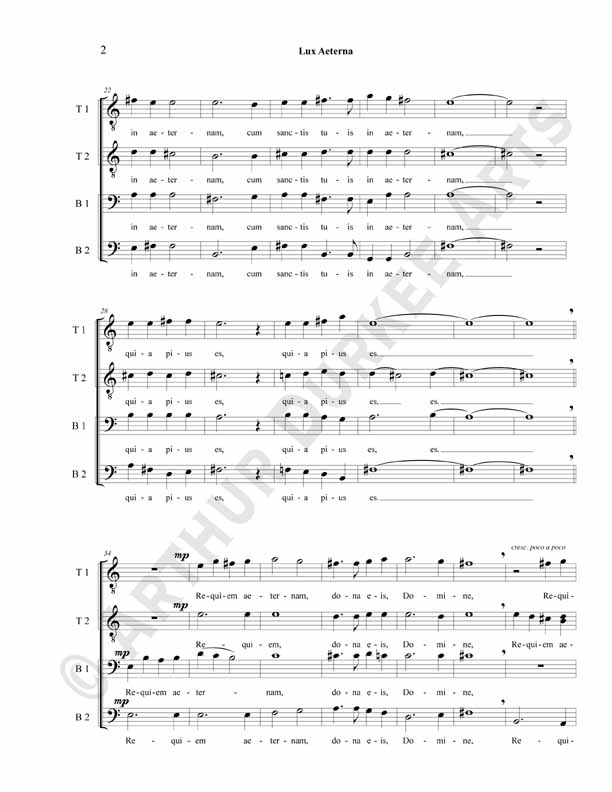
Here's a sample of the music, from the middle of the score, to give you a sense of the setting and musical style:


(Click on image for larger version.)

In just a few days, on December 8 & 9, 2012, "Lux Aeterna" will be premiered by Perfect Harmony Men's Chorus, in Madison, WI, as part of their 2012 winter concert series. The concert this year is themed as Warm Wishes from Wisconsin, and consists this year of mostly popular songs in gorgeous choral arrangements, a few novelties that will make you laugh out loud, and a few story-songs and carols that are powerful and moving, including some of the beautiful Alfred Burt carols. "Lux Aeterna" is the only sacred choral work on this year's winter concert.

I am pleased and proud to have my music sung by this group of excellent singers. I am doubly pleased that so many chorus members have told me that they like this piece a great deal. It is a piece in a fairly modern, somewhat challenging harmonic style (remember what I said earlier about depicting the text in its emotional impact), and they have worked in rehearsal, and that hard work has paid off. We will be premiering "Lux Aeterna" in a resonant performance space well suited to choral music, that will maximize the music's effect, so I look forward to hearing it there.

May the Light preserve and protect you, and lead you home!

Labels: , , , , ,

Saturday, March 10, 2012

The Adobe Church


St. Francis of Assisi, Rancho de Taos, NM


Cat in door of abandoned adobe building, St. Francis Plaza

Labels: , ,

Tuesday, February 28, 2012

Songs, Eros, Demons, Angels

Three books have come into my possession during the course of this roadtrip that make up a kind of trilogy of considerations of creativity. Each is self-contained, written for the author's own purpose; perhaps all that links them is synchronicity, and the connections they evoke in me. Nonetheless, they bring to the foreground what has very much been in my mind while traveling.

•

I haven't been conventionally happy on this trip across the Southwest and West. I have had moments of joy, and moments of real connection, real work. There have been some ecstasies. But overall my mood has been neutral to dark. Some of this is because of the reawakening in me—experienced again as insomnia gets me out of bed to write, as I spend a cold night in Jackson, WY—of emotions of violation, fear, agony, and despair: all remnants of the illness and surgery and recovery narrative of the past year. I lay awake in my bed tonight unable to stop thinking that my narrative of surgery is only half over: I am nowhere near done with this story, I am instead in the limbo between major surgeries, each them life-risking, dangerous, and powerful invasions of my corpus. My physical self finds it impossible to be cheerful just now. The rational mind, which of course, despite its delusions of grandeur, is the least aspect of the self involved in this process, finds a lot to be positive about. Indeed, many friends have been remarking how positive and life-affirming I seem to be, lately, when I talk about how I have more physical strength than I've had in literally decades. But to me that all seems like a lie: more accurately, a mask, a partial truth, a performance of partial completion. People want me to be positive, they want me to be well, and they want to avoid contamination by the angel of death still hovering over me, hovering closer than it's ever been. People want me to be cheerful, and happy, and feel good about life. The truth is: I don't. I feel neutral a lot of the time: not dark, not bad, but not jumping up and down with giddy happiness, either.

The truth is, I feel like I'm presenting a false face, like I'm lying. I'm not upset about this feeling, and I'm not feeling like there's anything wrong with talking to friends mostly about what's going well, rather than about my lingering fears and doubts. But there is a cognitive dissonance between the mask and what I feel inside, a strong disconnect between what I feel and what others want me to be feeling.

I'm still feeling distant and disconnected about art, about life. I still have no idea if anything I'm doing is any good. That doesn't mean I don't like what I'm doing: one or two photos I've made on this roadtrip will stand, I think, among my best work ever. One or two moments of inspiration, when I felt fully present, fully alive, while making art, writing, making photos: these stand out as ecstatic moments, the perfect moments that I seek out, as an artist, a musician, a writer. They stand out in high relief, more than ever, in contrast to the daily grind of mundane survival and ongoing medical narratives. (This is one thing I can't seem to get any of my medical team to understand. But then, perhaps it's so far outside their gamut that I'm speaking Martian to them. Certainly I feel like a stranger in a strange land.) So I can't really tell if anything I'm making now is any good. I just keep on doing it. That has to be enough. I can figure it out later. (The rational mind likes to think it leads, but truly it follows.)

The rational self really doesn't understand what this is about. Am I numb? Am I in some kind of ongoing PTSD-type emotional shock? Is it exhaustion? Perhaps. Certainly the blows have kept coming and coming without cease for months beyond counting. Am I just worn out by the real drama of life? I don't really know. I feel detached and disconnected even from caring too much about knowing the why of it all. I'm a little thoughtful about it, but by definition I'm not having any extreme drama about it. (At least not this week. There have been a couple of real meltdowns on this roadtrip, earlier, when basic self finally rose up and said What the frak has happened to me?!)

So I plan to just keep going. I have no answers. Other artists will let me know what they think of the art I'm producing. (Or not. Sometimes I feel a genuine vacuum of attention, and want more than I get. Then I remind myself to detach from that wanting.) Meanwhile, I just keep going. Tomorrow I will take the cameras and notebooks out into the wilds, and drive to the end of the road, and spend the day out there.

Part of me wonders if this detachment isn't part of my spiritual program, my existential post-surgery healing and life-story reassessment. I am, after all, suspended in the limbo between two major surgeries. (Again, those basic-self emotions have been coming up a few times along the road, now that I have leisure to face them: violation, shock, horror, mortality.) I wonder idly if this detachment I feel is not numbness but genuine detachment, an arrival at a Zen state, an actual detached state. It's true I have become very impatient with things that don't matter, the little unnecessary and pointless dramas of life—spiritual impatience, if you will. I get only hints of response to this question. I'm feeling unambitious about it—a lack of spiritual ambition—but rather humble.

As I've written before, the events of the past year and more have me seeing everything in my life from a new perspective. Everything has changed, and all the old maps are gone, while the new maps contain many obscure regions, many mysteries. That's probably the way it's supposed to be: Mystery and humility lie at the core of this distance I feel from life and art: this unknowing. In some ways my "I" has been taken away—that personality-ego upon which the rational mind is built—or greatly diminished. Certainly I know my own limits, my own mortality, as never before. Which is neither complaint nor praise, merely observation.

•

So the Universe provides me with reflections on life and art, and adds resonance to my unknowing in encounters with three books on creativity that resonate deeply with my process at the moment. I feel deep responses in myself to each of these three books, different as they are in subject, constant as they are in wonder. Each of these are books I want to engage with more thoroughly, individually; I group them here because of the synchronicity of their arrival in my life at this time (a crisis time in my creative life? or a post-crisis time?), and here I can give at most a taste of why they each are worth responding to individually.

Daniel J. Levitin: The World In Six Songs: How the musical brain created human nature. (Dutton, 2008)

I am increasingly skeptical of claims made by neuroscientists about anything, as there has been a growing tendency in neuroscience and brain studies to want to explain every aspect of human life through the lens of biochemistry. (While simultaneously explaining away the mysteries that remain.) The resurgence of militant "new atheism" has gone hand in hand with this. The problem is, neuroscience typically assumes a biological explanation for every facet of human experience, of human existence, and is unable to comprehend the synergy of body-mind: in other words, that the brain doesn't determine what we experience, it reflects and records it. It's not an operating system on a hard drive, it's a holographic storage device. In other words, in the language of Tron, we are users, not programs.

So I approached The World In Six Songs with this skeptical attitude in mind. I have to say, I was entirely won over by Levitin's approach, which is not to explain away life, but to embrace it. This is an artist's book as much as a scientist's. Levitin is himself a jazz musician, and brings that viewpoint to his brain studies. He extensively discusses creativity with many musicians from many walks of life: songwriters, composers, singers, jazz players, dancers, and more. The six "songs" the book is divided into are huge themes: friendship; joy; comfort; knowledge; religion; love. This is overall a very positive and life-affirming (and arts-affirming) book, not at all reductionistic, and not at all afraid to admit that there are mysteries we don't comprehend. Music (as I am quick to agree) has a power for us quite beyond the conceptual: music and dance are intimately linked, and go back to the origins of civilization, the founding of our species as self-aware. Religion grows out of our desire to make sense of the world: the dance and music we use as part of our religious practices are ways of organizing, of shaping our understanding: religious ritual is nothing if not performance of foundational myth, nothing if not reenactment of core faith. (Contemporary organized religion is often hollow precisely because it has become detached from the body, from the experience of contemporary life, and the enactment of myth rather than its mere recitation.) One other aspect of this book that deserves mention is its appealing use of pop songwriting lyrics to make its points about our biology; this is not only quirky fun, but quite convincing. And there are extensive interviews with great contemporary songwriters, including some profoundly relevant quotes from Bruce Cockburn, Joni Mitchell, and Sting, among others. I find myself agreeing with Levitin's responses to pop music a lot; for example, he shares my respect for Bob Dylan as a songwriter while also sharing my distrust of the slavish devotion of many fans.

William Everson (edited by Albert Gelpi): Dark God of Eros: A William Everson Reader. (Santa Clara University Press, 2003)

Everson was one of the great California Coastal poets, and writers about poetry. He was the self-proclaimed "lone acolyte" of Robinson Jeffers for many years, championing Jeffers even when his popularity was at low ebb. (Disclaimer: I am a member of the Robinson Jeffers Association, and have been deeply affected by Jeffers' writings myself. So I bristle slightly at the "lone disciple" attitude, even when it was merited.) Everson lived a dramatic, charged life, went through the equivalent of three religious conversions, and wrote darkly-muscled, often violent poetry that is nonetheless powerful, beautiful, and resonant.

This volume is an excellent, thorough introduction to Everson's work and life. In addition to a generous selection of his poetry, it also contains long prose sections of Everson's writings about poetry, about Jeffers, about hand-press printing—he was a master printer of fine editions of poetry, and founded several small presses during his lifetime—and about his personal cosmology regarding erotic mysticism: the truth that mysticism is rooted in the body more than in the mind. There is also a generous sampling of other poets writing about Everson, a posthumous selections of responses and appreciations. (Robert Hass gives one of the most revealing here.) I've been exploring Everson's writings about Jeffers for a little while, as part of my expanding research into Jeffers—my responses to the poet are mostly artistic, not scholarly in an academic sense, nonetheless I appreciate reading literary criticism about his work—and this is not my first delving into Everson's own work, although this is a deeper delving than prior visits.

Everson was a strong personality. As strong as his poetic master's, in many ways. As independent and uncaring about critical reception. Everson alienated a lot of poets and readers, though, with his often violent rhetoric, his dramatic changes of direction—all of them, in the end, religious responses to erotic embodiment as a spiritual path; which is one reason I find him so intriguing, as the mystical/erotic path is one I feel myself following as well. Everson remains in some ways as controversial as Jeffers. (These endless comparisons are brought in part through his own fault of identifying himself as Jeffers's disciple.) I find myself responding to his prose writings about mysticism and poetry, and their connection, as I do to the poems themselves. I have two or three other books just of his poems; I find this sampler gives me a way into the other books of poems which had sometimes been daunting.

Basically, what Everson left us with is a life-long passionate encounter with poetry, which engages you even where you disagree with him in some details. (As a gay man who has long felt sex and spirit to be one, I celebrate Everson's erotic mysticism and explicit depiction of sex in his poetry, even where I find his worship of the archetype of Woman, his imago dei, sometimes a bit difficult to appreciate.) In all phases of his life and work, Everson was fierce, passionate, and questing. I feel very much the same: I feel as Everson did that one thing contemporary poetry is severely lacking is enthusiasm, passion, and commitment. A lot of "cool" and cerebral poetry, a lot of ironic mannerism, still dominates the scene. Everson's writings are a tonic, a reminder that a genuine, sincere, non-ironic, unsentimental, and fiercely engaged poetry is not only possible, but necessary.

Edward Hirsch: The Demon and the Angel: Searching for the source of artistic inspiration. (Harcourt, 2002)

Unlike most art critics, poet/critic Hirsch does not begin and end with the artistic product, he is interested in how the artist creates, in what the sources of artistic inspiration are. He does not question whether inspiration exists—which is a somewhat unpopular critical stance in these Mannerist days of replication, sampling, and ironic distance from inspiration. I have every reason to recommend this book, as it goes a long way towards synthesizing everything I have ever talked about in terms of my own sources of creativity.

Hirsch begins with Federico Garcia Lorca's engagement with the duende, the "dark self" that Lorca saw as the source of artistic power and inspiration. (A translation of one of Lorca's seminal writings on the duende can be read here.) The duende is the demon, or more properly daimon, the ancient Greek term, of the book's title. Then angel is RIlke's terrifying angel of The Duino Elegies. Many artists and writers from ancient days through to Modernism have talked about feeling "taken over" by inspiration, almost having their work dictated to them—an experience I have had myself numerous times. I've written before how sometimes my most surprising, best, and most challenging work is written at white heat. There's a feeling of inevitability to what emerges, as though some greater part of the self was in charge, completely bypassing the everyday consciousness we normally work from.

The Demon and the Angel is a book of critical synthesis, a book of many short chapters in which different aspects of the duende and the daimon and the angel are considered in detail. In addition to a thoughtful, thorough response to Lorca, Hirsch discusses how the duende appears in all the arts. He discusses Yeats' daimon; Martha Graham's expressive solo choreographies; Rilke's angels; the American angels of Walt Whitman William Carlos Williams; Robert Bly's engagement with the duende in his essay Leaping Poetry; and much more. What I find exciting about this book is to read many of the same sources being discussed that have opened up the same questions in my own thinking, over the years. I almost feel as though Hirsch and I have been on parallel tracks. (Being a known poet and critic, he gets to publish his thoughts in book form; I on other hand just get to ramble on about them here.)

For me, one of the most telling of chapters here is where Hirsch discusses the late, black paintings of Mark Rothko. I've had numerous arguments with poets and artists about Rothko, about how to approach his work, and how not to dismiss it out of hand, as it so often is. This chapter on Rothko is ammunition in my future arsenal for conveying Rothko's essentially spiritual goals as reflected in his paintings. Hirsch discusses several of the other Abstract Expressionists, as well, as they are prime Modernist examples of artists who sought both abstraction and emotional content in their work. One of Robert Motherwell's famous "Black and White" paintings graces the book's cover.

On the main points about the duende that recurs again and again in Hirsch's book is how a sense of elation, of heightened liveliness, of ecstatic leaping, occurs in art whenever death enters into the room. I relate to this from my own sense of mortality and urgency to get more done, following recent brushes with death, surgery, etc. Perhaps the duende does come down to the truth of eros and thanatos, love and death, in the end. Lorca believed strongly that the duende was present when poetry or song fiercely chose to face and defy Death. In my own case, a literal encounter with dying and being reborn has led to many changes in the way I do my art, and the ways I perceive it. I was always attuned to the duende, though; it's just become more foregrounded now.

Hirsch points out that Lorca correctly identified the danger to art from the overly-rational intellect—the reason so much cerebral poetry is in fashion nowadays—but Hirsch also points out how evoking unreason risks evoking the deep strain of anti-intellectualism present especially in American culture. What I find contradictory about much American poetry nowadays is how it flirts with unreason, but uses rational control of its tools to strictly control it at the same time, often ending up with a dry, intellectually-rooted poetry that claims to be populist and anti-intellectual. Perhaps one reason that non-poet audiences feel unable to engage with poetry nowadays is that on some level they sense they're being lied to, that a game is being played at their expense.

The Demon and the Angel is a very rich book. I feel I could on about it at length. (Which I will do at another time.) It speaks to me on a very deep level, partly because Hirsch has gone exploring for the sources of creativity in many of the same place that I have myself. Perhaps this book will resonate more with artists and poets than it will with the general reader, nonetheless I would recommend it to anyone. It touches on so many necessary bits of knowledge about the creative process that I wouldn't hesitate to loan it to a non-artist friend who wanted to know more how what they discover in my own art got there.

I have said more than once that there are mysteries in the artistic product: things in there that I didn't know where there, that some audience member discovered and told me about—which is something I like. I like the fact that some smarter part of me put that in there, that my rational mind didn't know about. This book is a big help to all involved, towards a deeper understanding of how that actually works, how it happens. I will need to spend some serious time with this book, myself, as it has already clarified my own thinking.

Labels: , , , , , , , , , , ,

Saturday, October 15, 2011

Process of Writing 24: Forward Momentum and Emergent Order

I've overheard myself say lately that I'm on a creative roll. The truth is, I'm at a point in the project of writing the new music commission where the writing has become easier, more fluent and fluid, and so I get a lot done each week. A few weeks ago I wrote three songs during the week; I've been averaging about two songs per week since, with some weeks only getting one song done, due to external circumstances that have prevented me from sitting down at the writing table. Not bad distractions, just logistical things that need to be taken care of.

When you finally get the ship going and build up a good head of steam, it keeps going for a long time, and requires effort to slow down and stop. In physics, it's called the law of inertia, of forward momentum: A body in motion tends to stay in motion, a body at rest tends to stay at rest. (Yes, that's a law of physics, not just a tag line for a TV commercial for some energy drink for athletes.) So I've built up a creative head of steam, now, and am in what athletes like to call "the flow"—that non-ordinary state of consciousness where each move seems simultaneously spontaneous and pre-planned, where the tip of the paradox is that you are moving very fast but to your own perception there seems to be lots of time in which to observe and make decisions, choose paths, decide on tactics within your pre-planned strategy. (Tactics are the operations on the ground. You may have a per-planned strategic goal, and strategy is how you plan to reach your goal. Tactics are what you use in the moment, always adjusting your forces to approach maximizing your end strategy.)

It's easy to get pulled into watching a video or film or TV show and forget that what you are seeing is not continuous motion but a fast series of still frames. Moving pictures are an illusion. To create the illusion, we rely on the persistence of vision, which is a trick of the eye and of perception. The light coming into the eye lands on the retina, triggering bio-electrical waves in the neurons of the eye's sensor elements. Being biological rather than electronic, the waves of neural transmitters take a moment to pulse, and each pulse takes a moment to fade away. So, if you show 24 or 20 frames a second in the front of the eye, it perceives it as continuous motion because each frame lingers in perception long enough to overlap with the next frame, and create the illusion of smooth, continuous flow. You can affect the viewer's experience, in fact, by changing the frame-rate. (Of course, all this could be wrong. Some people like to think so, but seem to have no better explanation as a replacement.)

How can I describe how I feel when I write music? The persistence of pencils? Neurological inertia? The truth is, when a musician looks at one of my scores they perceive it as a seamless, continuous flow. But the writing proceeds by fits and starts, frame by frame. I build up what feels like a static charge of restlessness, when I sit and write for awhile. What I usually need to do is get up and walk around, go do something else for five or ten minutes, then come back to the writing table. I'm sure some writers will view that as seriously undisciplined, but maybe it's just another kind of discipline. The static charge analogy is a good one, because it describes how I literally feel after a half-hour or so of intense concentration on writing music: like I'm about to get struck by lightning. I have to walk it off.

I'm aware, too, that the static build-up is also about catching up to where I am in my mind with the writing. More precisely, I've caught up with writing the notation to the point where I have written down as far as I could go, and I need to go do something else to let the inner voices recharge and give me the next bit of music. This is very hard to put into words. It can feel like waiting to take dictation. Even though I am making musical decisions, and using all my craft to bring the musical idea into being, the inner process is at core very intuitive. it's all about listening with the inner ear.

People complement me for using a particular musical style for a particular piece, assuming it was my conscious intention. (In typographic design, the principle of transparency is often cited: That the type should be the transparent glass in which the wine of the text is contained. If the type is set up ideally, you don't notice it. ¶In poetry, the principle of transparency is similar: The perfect form to suit the content, form following meaning and function.) But as with writing poetry, I don't know what style the music is going to have until I hear it with my inner ear. True, I hear it before I write it down in score notation, but it often arises when I'm reading the lyric through, thinking about what music to use to set it. I might have some idea going in, but it really depends on the inner ear. Sometimes I have even had to reshape the lyrics, once the music started coming, to make them a better match.

This really is hard to describe. Basically, it's about listening to those inner musical voices, which is very intuitive, then using what you hear as the kernel of what you write down, at which point all your knowledge and experience and craft comes into service. The craft and music theory I have learned, which is more than most people ever even imagine, is all in service to the inspiration. It enables me to notate what I hear inside.

Back in music school, all they could teach us was craft. You can't teach inspiration. It's there or it isn't. You can teach how to be receptive to it, but you can't force it to come to you. There was a lot of bland music back in music school, a lot of failed experiments, as we composition students fooled around learning out craft, and often not having much to say. Having something to say is essential, in poetry or in music, or everything you write is hollow, or worse, if it's self-congratulatory for no real reason.

Getting up and walking away from the table, then, is a chance to let that creative voice inside you take a breath and decide where to go next. I can talk about it using analogies to other arts. Creative process is similar no matter what art form you're working in; or I should say, it is similar for me, who practices artistic crop rotation. So, analogies. Stepping away from the music writing table is like painters stepping back from their painting to look it over for awhile, till their eye sees what needs to be done next. Lots of non-artists think that everything artists do is all planned out beforehand, very consciously and deliberately, but that is rarely so. Many painters "follow the brush" at some point, and make decisions during the creative process that surprise even themselves. I am constantly surprised by the music I write, finding things in it later that perfectly support what I am writing, but I wasn't conscious of them being there while I was writing them. I've gone back over sacred music I've written and found numerological and geometric resonance patterns that enhance the meaning of the text, operating on some subliminal level even the composer wasn't aware of till I went back and found them.

Of course, that could partly be the human habit of consciousness that likes to find patterns in even random systems; call it the persistence of form in consciousness. But chaos mathematics has demonstrated very well by now how order is an emergent property, how self-organizing systems arise out of chaos and create self-consistent patterns. This in fact may be how amino acids converged in the early era of our planet to organize itself into life as we know it.

Like many others trained in the sciences, I have no problem believing in a higher level of being, a Great Spirit or whatever label you wish to use, and I find that the mechanisms of how life organizes itself are beautiful and even divine. The problem with the anti-science religious-right creationists, who are for the most part scriptural literalists, is that they have taken a mythic story, a simple story, and tried to explain it as literally true. That is the root error that spawns many others: the belief that mythopoetic scripture is literally, factually accurate and true. They may be right in that "In the beginning God created the heavens and the earth," after all every story has to have a beginning, even the story of spacetime—but they are flat out childish and naive in their explanation of the mechanism of Creation. The story of Creation given us by emergent order arising out of chaos, of self-organizing systems that emerge and evolve into life, is no less a divine story than some anthropomorphized deity waving his hand and making everything in less than a week, some four thousand years ago. In fact, emergence is a more elegant, more wondrous, more beautiful, and more coherent and attractive narrative by far. It contains no less of the divine spark. As a story, like all life, it glitters from within. Visionaries can see the sparking of the mitochondria powering the cell. The fire of life that supports all life, that is the power under life, which can perceived even by the science-trained as divine in source and origin.

The desire of scriptural literalists for a simplistic, even childish, literal story proclaims their unconscious desire to remain children before their God, and never grow up: never be allowed to grow up, never want to grow up. It is an infant's narrative of total dependency on the absent parent. It expresses a desire to remain infantile. Well, adult life can be complicated, and require that one take personal responsibility for the consequences of one's actions. That can be daunting. Some people never do want to grow up, and do everything they can to avoid it. And if not remain infantile children, then remain sheep guided by a shepherd. But anyone who has ever herded sheep, especially up in summer mountain pastures, knows how stupid and helpless sheep really are, unable to get themselves out of trouble without assistance. Is that really who you want to be? Is that really your divine image? The Adult who keeps you a child, the Shepherd who makes you be a sheep?

In my theology, which is not mine alone, the Adult wants you to grow up and become an Adult yourself. The Divine leads by example, not by dictatorship. The lesson of mysticism, as it has appeared again and again in every age and location on this planet, is that experiencing the Divine directly is everyone's birthright. We can all see the sparking of the mitochondria, or the growth of the seed into the tree. All you have to do is look, and watch, and see. It's not hard. It doesn't require special talent or guidance. Intuition and vision is a skill that can be trained, and has a craft to it that can be taught—just like in music school, in art school, and in other creative disciplines.

In my theology, artists are co-creators with the Divine. Everyone is creative, and capable of co-creating with the Divine, although not everyone is overtly an "Artist." Not everyone paints, or writes, or draws, or invents a melody to sing. Well, actually, that's not true: Everyone does do those sorts of things, but in our culture where "artist' is categorized as a discreet profession separate from everyday life (like most jobs, like jobs from which one "needs a vacation:) we tend to view artists as a special class. In other cultures, especially in certain indigenous tribal cultures, everyone is an artist because everyone engages in handicrafts. Ordinary objects are decorated by their owners, who made them, who did not need to go to a specialist to make them, and did not need to hire a specialist to decorate them. We in Western culture have a real blindness about this, because we assume artists are specialists; in fact, we tend to overlook or dismiss this very level of continuous creativity made every day by ordinary people precisely because it is not specialist art, not seen as different and special. We overlook the masterpiece of bone-carving made by an Inuit hunter from the tusk of the walrus that he killed to feed his family last winter, because it's not the Mona Lisa hanging on a museum wall. Western culture is very blind about this. We ignore handicrafts by dismissing them as "handicrafts" when in fact they are the source and origin of all "higher art." They are the emergent order rising out of creative chaos. Even great painters made finger-paintings and humble sketches when they were children.

How did I get here? I was talking about creative inertia: A body that is in the creative flow tends to stay in the creative flow. As I've expressed it before, one the basic laws of creativity seems to be: The more you do, the more you do. Creativity becomes an anentropic self-generating power station: a genuine case of perpetual motion. The more you make, the more you are able to make. This is partly the practice effect, how practice hones and sharpens skill. Raw talent is inchoate and chaotic, not knowing how to do what it wants to do; learning craft that supports the talent turns the talent into a skill: a disciplined, orderly practice that emerges out of inchoate chaos.

The connection between creativity and Creation is obvious: Both are Order emerging from Chaos. This is why when we are engaged in creativity we are co-creators with the Divine. It's not that we are only co-creators when we're making art, it's just the connection is more obvious at those times.

So I have forward momentum. And I'm approaching the completion of the new music commission. This doesn't mean that everything is suddenly easy to write. Some pieces flow very quickly onto the page. Others I still struggle with. I admit that today was a day of some struggle, but I did manage to finish the piece I was working on. Tomorrow is a new start. And we go on.

Labels: , , , , , , ,

Sunday, May 08, 2011

Process of Writing 8: Dulcimer Song Etc.


Dulcimer Song        AD, mountain dulcimer

Improvising on dulcimer this afternoon, making a piece in 7/8 out of nothing. Ideas lead to other ideas, and the next you know, there's a new piece coming out of it. Now, take the dulcimer lines and arrange them for piano and chorus.

Flexible line lengths in the musical phrase to accommodate the flexible line in the lyric.

A song about home, about the hearth, about country life, on the farm, going to Sunday church meeting. Singing around the parlor piano, singing hymns in the church accompanied by the wheezing old pipe organ.


Tonight I finished making a loop-based ambient/techno track on the studio computer. I've been working on it, off an on, for about a week. Just sitting down for a little while every other day, and adding to it, editing it, refining it, till it was all shaped up. I figured out how to end it, tonight. It turned out to be about 10 minutes long. I plan to take this as the rhythm bed for an ambient piece that I will mix together now, using other materials, maybe recording a new bass line, or flute line, to put with the existing rhythm bed.

I can only work on music for a few hours at a time. After a few hours, your ears get tired. You need to stop and go do something else for awhile. I can only record and mix for about four hours at a time, usually. After that, my ears are too tired and I start missing things, making mistakes, not being able to hear and decide about what to do next. I've done longer recording sessions, to be sure, but four hours is about the maximum amount of time I can spend on any given piece during one session. Sessions that go longer are usually addressing multiple tracks, so that when you ears get tired of one song, you step away for awhile, then can come back and do another song. More fresh that way.


After improvising on the dulcimer this afternoon for awhile—it's a mountain dulcimer, the three-stringed variety that you rest on your lap and strum, fretting the notes to make the chords and melodies—I went out for a drive. Just to get out of the house, clear my head, think about other things for awhile. I went for a drive, for about an hour, and ended up at the grocery store, to restock the victuals in the larder.

As so typically happens, it's when I'm driving, or walking, or otherwise in physical motion, that ideas start coming to me. So I got the idea to take the dulcimer song and use it as one section of the new music commission. The scene and setting are inspired by folk music, the kind of simple music made on simple instruments, played on the porches or in the kitchens of immigrant farm houses for generations.

So this is an instance of the music coming to me before the lyrics, and the lyrics being fit into the idea of the music, which in turn will get stretched to fit with the words.

One of the stories that has come up for the new commission is about growing up on a rural farm, going to church on Sundays, being part of the community. And eventually coming into some sort of conflict, either externally or completely internally, with being gay. Being gay in a small church-going town has two outcomes, typically. One of those is acceptance by family, friends and community; of being supported, of still being part of the community. One story still has the gay man in question, all grown up and out of the closet now, still occasionally going back to his small town church, and preaching a sermon. Lay preachers are not uncommon in small town churches.


Folk music is a big part of my musical roots. I spent a lot of time in college exploring all kinds of musical sources, singing and playing in various groups. I was in a madrigal group, and another choral group that focused on performing Medieval and Renaissance music. I also participated in the folk music scene—which back in those days in Ann Arbor meant going to frequent shows at The Ark, and sometimes performing there, too. I was part of a small group of improvising musicians who played new age music, folk music, world music, and various combinations thereof; I remember a lot of gigs we played at the Friends' Meeting House in Ann Arbor, a good room for chamber music, and a supportive community who always came to concerts even if they had no idea what to expect.

Folk music and Medieval music have a lot of concepts and styles in common. The division between "folk music" and "art music" didn't really develop until fairly recently in Western music history. The peasants sang in the cathedral, and the cathedral choirmaster used commonly-known folk songs in the composed music, as well. There was exploration and experimentation, but when you want the music to appeal to the people, and get them to sing along enthusiastically, you have to keep it simple, keep it plain. Folk music forms and idioms are ideal for that.


So it make sense to me, now, to incorporate some of this idiom into the new commission. I want to fit the musical setting to the lyrical subject matter. A story about singing in church, singing at home around the parlor piano, and finding other ways to worship, strikes me as an ideal opportunity to delve into folk music settings.


The chorus singers might balk at first about singing in 7/8. But once they get a feel for the rhythm and melody, I'm sure they'll find it fun.

A lot of eastern European folk music traditions (Bulgaria et al.) use odd meters, like 5/8 and 7/8 and even 13/8. Or they will subdivide a more symmetric even-numbered meter such as 12/8 into uneven segments. A common way to subdivide 12/8 in these folk music traditions (which are also their country's art music traditions, too) is 3+3 + 2+2+2.

A favorite way I like to subdivide 12/8, which I have done in both jazz and classical pieces I've written is 5+7. (You can hear that pattern in operation in my piece Kanjo for frame drums and Chapman Stick.)

It's really not hard at all to sing in odd meters, even for people who are used to always singing everything in 4/4 or 3/4, which are the dominant meters in Western popular and classical musics alike. The trick is to hear the melody as a rhythmic sequence of notes, and not think too hard about the meter. just learn the song, and don't try to analyze it while you're learning it. That makes it very practical.

So notating this dulcimer song for chorus is next on the commission agenda. Maybe tomorrow afternoon I'll have time to sit down and write it all down.

Labels: , , , , ,

Thursday, April 28, 2011

Struggling with Form

Struggling with form, with how poems break out of you and take shape, sometimes beyond your reckoning.

I've said all this before. Sometimes it bears repeating again, just to keep it in mind. And, perhaps, with each contemplation you circle around a little bit closer to the truth, and state matters a bit more clearly. Perhaps in the end approaching something like a creed.

It's unfashionable in this overly rational, left-brain literary day and age to be a writer who goes on intuition and instinct. I take a lot of flak for that. Those who want to tell us how to write seem to want us to be always mentally prepared, intellectually alert: as though knowing exactly what you intend to do, even having an outline, makes for better writing. That sort of pre-planning may be very helpful when writing a murder mystery or an essay, writing in which narrative plot or the sequence of ideas matters, but it can by contrast stifle spontaneity. Lots of prose writers, when they first attempt a poem, make the mistake of thinking that prose rules apply to poetry, where they do not.

For me writing a poem is entirely about spontaneity. A poem comes when it comes. Sometimes I can feel the urge, feel it coming, before it arrives. Sometimes I sit down to wander through my journal, and the next thing I know a poem has written itself, almost entirely without intention or conscious anticipation.

It's also about receptivity: I keep my antennae tuned, as it were, to the poetry wavelength and bandwidth, like keeping your radio astronomy dish pointed at a specific location in the sky, waiting to hear what comes down the aether and into the wires. The discipline of writing that I follow is not to write every day, or try to; it is, rather, to simply be ready. When a poem floats by, you have to be ready to catch it.

I don't write a poem a day, I wait till I feel like a poem wants to be written. I don't go looking out in the forest for poems, I wait for them to knock at my kitchen door. I don't go seeking poems out. I don't set out to Write A Poem. Sometimes what I find myself writing in the morning doesn't turn into a poem, but into something else. I find myself caring less and less about those definitional boundaries between "prose" and "poetry," and cross back and forth over that line without any regard for it.

Maybe that's a passive, feminine, anima-based way of being a poet, but it seems to me that the animus-based, masculine, active ways of being a writer often result in carefully-structured, taut, body-built Poems For Engineers. Poetic culture has become dominated in this age of celebrity cults and marketing by extraverts, and one thing that has always been true is that extraverts rarely understand their introverted cousins. Even though writing can be a very inward activity, often done in silence and solitude, not only introverts are writers, and publicity is itself a very extraverted activity in a culture dominated by extraverted attitudes. Historically, poetic culture has always been tied to listening, to the muses, to right-brain forms of consciousness: until the Modern era, which became dominated (perhaps in reactionary overthrow against late Victorian Romanticism) by left-brain, conscious direction.

Even the Surrealists, who delved into the unconscious for inspiration, took what they'd harvested inwardly and shoehorned it into left-brain modes of writing, the forms and styles already in existence: they were still active and decisive, rather than passive and free-flowing, in the Taoist sense; and unlike the Dada artists, they were still invested in creating artistic respectability. The Surrealists may have wanted to mine the ore found in the right-brain chaos, but they still wanted to refine that ore into the polished chromium gleam of dominator-culture showpieces in brightly-lit galleries. They took what the unconscious gave them, and used it: not on its own terms, but still under their conscious direction. (Magritte as ever was the exception, and he openly stated that he thought of himself an explorer of consciousness, not as a Surrealist painter.)

I usually don't know what form a poem is going to take until after I've started writing. Usually by the third or fourth line, the poem has revealed its form. I rarely set out to write within a specific form, dictating form before content emerges. If you want to adjust form later, during revision, that's a separate yet equal concern.

Form is often revealed in the writing of the poem, then. It doesn't pre-exist. I've invented a few new forms, over time, which began as something stumbled into, or revealed, but which I then might use again, if I liked the structure it gave. Most of these invented forms aren't like things you see in free verse lyric poetry, which of course is a free zone for inventing new forms, or avoiding form. I do agree with those poets who theorize about form emerging organically from the poem's content, about how content dictates form. I feel that way, most of the time, myself.

The only forms I regularly write in that aren't either spontaneous or invented are those I've fondly adopted from Asian cultures: haiku and its related forms from Japan; the Chinese and Indian classical forms. Mostly haiku and haibun.

I think if you worry too much about form, you end up meaningless. This is not about meaning in your writing, poetic meaning, meaning in your poems: it's existential. It's meaning-of-life. It's whether or not your life is pointless and meaningless, or if (following Albert Camus, following Viktor Frankl) you are able to generate some meaning you can hold on to, that gives you a reason to endure the rest of it. Form is inherently meta-meaning: some poets (mostly neo-formalists, but not exclusively) cling to form as if to a life-raft, something to hold onto lest they drown beneath the sea-cliffs of chaos. The over-emphasis on form, and on craft, often seems to be driven by fear of chaos, of formless free-floating anxiety about the absence of a keel and rudder with which to steer through life, be it moral, ethical, religious, philosophical. Whatever mode of structure that gives form to a life, to remove fear of the Void, that is what is clung to.

Another way, not a better way, just an opposite way, is the embrace of the Void—out of which meaning can also be wrestled, but not by imposing a pre-existing structure out of fear. Rather, by finding in oneself the code of what one believes to be right livelihood, right interaction, right work, right action. There can be a thin line between Buddhist psychology and existentialist philosophy, when apparently divergent paths arrive near similar endpoints. When one stands on the lip of the Void, looking in, sometimes one discerns a Smile on the face of the Void: an awareness that there is something living in there, something maybe worth living for, where it seems there is Nothing. The vision of the Void comes in pairs: first the despair, then the acceptance. First the horror, then the realization that one can still go on living: even if one must create one's own meaning in life, or discover it. We seek meaning, even if that meaning is nihilistic or based on other kinds of rejection, rebellion, reaction. The angels who rebelled against Heaven are the same archetype as any teenager rebelling against parental authority. When an angel grows up, it realizes that maybe, the parental was the friend after all, and they discover themselves to have evolved into their own parents. Form can be similarly self-generating.

There appears to be some function in the Universe that generates emergent order. Systems formerly inchoate become complex enough that they generate emergent patterns of governance. I don't know if a divine impulse is necessary to propel evolution, since self-organizing systems seem to be the way all life coheres. You and I are not singular organisms, we are vast collections of trillions of self-organizing cells; and living cells themselves have been anciently colonized by symbiotes and parasites, each performing a function within the generator. Discrete organelles, the mitochondria that power us were once invaders, then symbiotes, now integral sub-systems.

Poetry can be similarly self-organizing and generative. It does not have to be willed: as though the will alone was all that's needed for creativity. Thinking the will and intellect alone are all we need to generate poetry is what got us into this postmodernist mess to being with; and you cannot think your way to a solution of a systemic problem by using the same kind of thinking that got you into the problem to being with. Organic form emerging from the writing itself is like a biological self-organizing system—if not exactly the same, the analogy is still useful.

That self-organizing systems can emerge from primordial unorganized soup affirms the mathematics of chaos theory, in which it can be shown that order does emerge from apparent chaos, and that meta-levels of order are present even in fully turbulent, chaotic systems. There is nothing truly random in nature: what we perceive as chaos we simply haven't understood as ordered, as yet. This lack of randomness in the Universe is a great mystery. Many seek to interpret it as a divine impulse, a primum mobile, an original creator's impulse. I've always found it ironic that both religious texts and many poets hail the source of all the Universe as beginning with a single Word. It amuses me that many poets, especially those who believe in the primacy of words over all other artistic media, are sublimely unconscious that their laudation of the Word is a primary religious instinct. The left-brain rational form-worshipping poets are essentially worshipping at the altar of the First Word.

But there are other metaphors of creation, equally self-generative. The First Light of the First Day, an explosion of Light as the big bang. The First Sound, which is not a word per se but a Voice, singing. I wrote an aphoristic poem, years ago, following a visionary experience, that remains, for me, a summation of the nature of the divine:

For God is
an infinite voice

singing

in a place
filled with

Light.


One of those insights and intuitions that just comes to you, in the same way that poems do, and maybe from the same well or river. After all, making art is bound up with Creation: we even call it "creativity." That's no small word, in any context, although we often take it for granted, rather than contemplate its truly puissant nature. It would be catastrophic to go around on a daily basis surrounded by perceptions of the true nature of the Universe, those fields and flows of energies and particles, the lack of solidity of matter, the truth that everything is in vibration, expressed as frequency and amplitude, which is what a singing voice is: pitch expressed as frequency and amplitude within a carrier medium. We are immersed in a breathable atmosphere, the outer skin of our planet's systems: air, which transmits sound, fluidly and sensually.

So poetic form, to follow this existential conceit to its conclusion, is a religious, biological, mineral, energetic necessity. You cannot actually separate form from content—except arbitrarily and intellectually, both of which in the end are illusory. Thus, to let the poem invent itself as it proceeds, to let it determine its own emergent, organic form, is a form of worship. Perhaps closest to the root of awe, the Taoist flowing acceptance of the energies behind appearances makes the most sense as the structure of a Way of Poetry, a religious practice of poem-making, a Way of enlightenment not distinct from Zen or the Tao as a path towards completion, fulfillment, and transmigration. We all evolve from chaos into order—but the order is self-organizing, not willfully imposed from without by a structured ideology we'd rather believe when we can't deal with what we actually perceive.

Labels: , , , , ,

Tuesday, December 28, 2010

Sacred Music


This image means a great deal to me. It's from the 1920s or 30s. (I don't have a full attribution for it.) It's an image of the great three-faced image of Shiva from the caves on the island of Elephanta, in India. Seated at the base of the sculpture is a sarod player, a young master musician, who no doubt went on to have a full career as performer, teacher, musician. I found this image in a book about Elephanta, and when I turned the page and saw this photo, it stopped me cold. It says everything I want to say about music, my relationship to the numinous, the Divine, and how these are essentially One.

I've said it before, but let me say it again, because it's true, and because I really mean it:

Music is sacred to me.

Of all the arts I practice, and there are several, music is the most central to the core of my being. It's the one that means the most. It's the art that is a sacred art, one could even call it a religious art. Although I am in no sense traditionally religious, music is what links me to the religious sensibility, the religious aesthetic. It's in music that I share common ground, along with many other musicians, to the numinous, the liminal.

Bach wrote at the end of each completed score of music, Deo Gratias, "To the glory of God." I understand the impulse to say that, I understand the feeling behind it. It's not language I would use, but it's language I can feel, and support.

Visual art is something I really love doing, but I'm always pushing at it. It doesn't always satisfy me on a deep level. Sometimes it feels disconnected, the imagery too mental, too imaginary. It can be virtual, rather than fully sensual. That's partly because our entire culture is dominated by a bias towards the visual—over the other senses, and also as a learning channel—and so visual art is both accepted and easy. People accept my photography and digital art more readily than any other work I do. We have a visual vocabulary, a very rich and complex one—and it contains things we can't always put into words, symbols that resonate on a deeper level. At its best, for me, my own visual art activates the archetypes, and creates resonances beyond the purely visual. There is a hum of the Divine in its presence, when it takes on its archetypal aspects. The best visual art is shamanic—not necessarily in terms of imagery, but because it seems to open into worlds that are visionary, transcendent, and full of emotional and spiritual resonance.

In my visual art, in those pieces that mean the most to me personally, there is often something mysterious, inexplicable, archetypal to be sure, but not always obviously so in terms of imagery or style. I find myself drawn again and again to certain images that for me are very alive, very powerful, that seem to evoke the Mystery, and the gods. This photograph of Shiva with a musician at his knee is one of these images. I've made more than one photograph I've made of statues of Shiva dancing into an archetypal icon of my own.

In my written arts, in poetry, in essays, in writing in general, I have often admitted that words fail me when it comes to trying to describe the numinous. The closest I can get to evoking—not simply describing or reporting, but evoking—the Divine as I have experienced it is in visionary poetry. I've written more than one poem that is a record of a visionary experience, a waking dream, a moment of gnosis—whatever arbitrary label we want to use, that allows us to box the Mystery into a convenient and unthreatening categorization—and while such poems are records of experiences, the use of poetry as the language of recording seems essential, since poetry itself is heightened language, more than ordinary words or talk-talk. Poetry can raise language to the sublime.

Nonetheless, words often fail. They just can't contain everything we want to contain in them. In the end, words even betray us, by making something ineffable seem ordinary, in the inadequacy of telling about it. Our culture is dominated, in the linguistic domain, by a bias towards linear narrative, towards straightforward storytelling—and against the sideways or nonlinear pull that poetry can bring into consciousness. This is one reason, obviously, why prose narrative is far more popular than most poetry, which even in linear narrative forms tends to be incapable of being fully tamed. Poetry is always a bit wild, even when we try to domesticate it. It keeps seeping out around the edges, keeps flickering in and out of the light and going to hide in the shadows.

My own poetry, at its best, is not at all tamed. I don't want it to be tamed. I want it to remain wild and unpredictable, even to me. Some of my own favorite poems surprised me: I had no idea where they came from, and what they said was so unexpected that it was a new idea, even to me. Far too many readers of poetry, and even poets themselves, try to pretend that poetry is predictable, and manageable; formalist poets in particular carry around the totally-unsubstantiated idea that all poems are planned, intended, intentional, and created at the will of the poet. Wiser poets, based on the reading that I have done in poets' essays and memoirs about their art, seem willing to acknowledge that they don't always know what's going on, that they cannot always manage their poems, as though they were tidy little boxes that could be stacked and sorted in the warehouse of memory.

My own favorite poems that I have written—although, to be blunt, it often feels as if some part of the Self was in charge of the writing that is not the "I" of the ego-personality—or that have emerged from my pen, are those poems that take my out of myself, and into something greater. In ancient Greece, poets and dramatists and other artists spoke of being possessed by their daimon, their dark spirit, or of being possessed by their god, and speaking truly, as an oracle, for that moment of creation. That's an experience I've felt, being taken over by something greater than myself. I marvel at some of the writings that have emerged at white heat, when I've felt taken over, or as though I was merely a little hollow bone for Spirit to blow through. I marvel at those writings in part because they don't seem like they're mine—rather, that "I" cannot claim ownership of them without sounding arrogant and egotistical to myself—and in part because things were said that in some cases were brand new to me, as well. Writing like this is not purely self-expression, nor is it a deliberate attempt at expressing an existing thought or opinion. Some writers have said that they don't know what they themselves are thinking about a topic until they write about it—I can relate to that, although what I'm discussing here goes deeper. I'm trying to avoid collapsing into the usual clichés about writing, while at the same time trying to discuss what is numinous and liminal about the experience of having written something that surprised even yourself. There is indeed something special, something spectacular, about witnessing even your own writing, when it gets to that numinous level. When you're in the flow, in the groove, writing at white heat, feeling inspired—whatever label we want to give the process to try to box it into some unthreatening categorization—it's an amazing feeling. It's beyond rewarding: it's what we live for, as artists.

(Language capable of supporting discussions of the numinous and liminal does exist, but it's more likely to be found in the literature of mythological and anthropological studies, and in the literature of psychology, than it is to be found in the literature of either literary criticism or poetry criticism. The literature of literary criticism has become particularly anemic about discussions of the soul in art. Lit crit has turned largely towards the head, and away from the heart, and lost all sense of enchantment.)

Having said all that, I must return to the essential: For me, whatever numinous experience I might attain from writing, or making visual art, music is even more so. Multiply everything I've said so far about writing, about art-making, and for me, music is even more so.

I'm lucky in one sense about my music: I've made my living from it occasionally, but haven't really had to compromise much to do that. I've made much more of my living doing visual art, doing commercial illustration and design—as a result that's both why I can be egoless about it, when a client asks for a change in an illustration or design, and why I sometimes feel like my visual art isn't as meaningful, is more detached somehow. When I'm doing commercial art or design, I long since got over any pretensions that it was anything more than art made to spec, for clients or art directors, and not fundamentally mine. At the same time I was doing commercial art, I was doing my own fine art, on the side as it were. Occasionally there was overlap, but mostly those domains stayed separated.

I've noticed a tendency among young graduates from design school, who are full of great ideas but don't much real-world experience yet, to believe that what they're doing as commercial artists has a higher Purpose, is in fact Art. But it's not. I read, in the literature that designers write about what they do, many of these same pretensions: that what they're doing has some higher purpose, that great design can change the world. Mostly it doesn't. Mostly it's commercial work for clients. Mostly it doesn't have the opportunity to Change The World. (Occasionally it does, but only rarely.) Designers have the chance, every so often, to create an idea or iconic image or logo that permeates the public consciousness, that is "viral" in the sense that it spreads and self-replicates and keeps popping up in places beyond its original purpose or intent.

But remember that most such viral ideas had a single purpose at their inception: to exercise the imagination in order to get you to buy something. Even Andy Warhol's Campbell's soup cans, as abstracted and iconic as they are, contained an inherent, unavoidable commentary about consumerism—precisely because the image evoked the commercial product. That was deliberate—and subversive, when it was first done. now, post-Warhol, when you see this maneuver done in postmodern art, do you think more about the art, or the product?

I'm lucky in one sense, therefore, that my music has rarely been dominated by commerce. Not that I never got paid for my music—I've sold my share of CDs—but that I wasn't required to modify my music to suit the tastes of the buyer. I've had the artistic luxury, with my music, most of the time, of not having to give a damn what anybody thought about it, and could just do what I wanted to do.

(This may be about to change in the near future. More on that later. And it's why I'm thinking about this today.)

I've heard a dance master, a man who is both accomplished dancer and choreographer, opine that you can't hide in dance. It's too revealing of the self. You can try to act, but in the end, you're always naked. I think the same is true of music. In poetry, and perhaps even more in prose, you can hide: you can present characters who are not you, who are nothing like you at all, yet who are real people to those who encounter them. Dance is done with the self. It leaves you very vulnerable and exposed. Music is the same. When you are on stage, performing music, or performing music you have written, or improvising on the spot, you are incredibly vulnerable, incredibly open, incredibly naked to the world, to the environment, to the feelings of those around you. That is music's (and dance's) great joy: that living connection with others, in the moment, in live performance.

It's also music's great challenge, and great obstacle. Some very private people have been master musicians. In some cases they have talked about how painful it is for them to perform, how they felt too naked on stage, too vulnerable. More than one biography of pianist Glenn Gould has suggested this was one reason he quit performing concerts at the peak of his career. Gould's technique as a pianist, and his radical ideas as a composer and radiobroadcast producer, were stellar, probably even on the level of true genius. But he had many personality quirks and eccentricities; he fought with feelings of isolation, with depression, with disconnection. His musical work was magnificent; I think his radio work for the CBC was equally brilliant with whatever he did at the piano. Nonetheless, he himself said in an interview that playing music onstage was sometimes too painful to endure. He was, I believe, torn between his need to express himself musically, and his strong tendencies towards being an eccentric hermit, a complete isolate.

I don't suffer from Gould's distaste for the audience. When I'm performing music before an audience, I love the connection that happens on the best occasions, when it feels not as if they were passive receivers of your music, but as if all of us were taking a journey together. Taking a journey—together. I might be driving the train, but no one is left behind who wants to come along. That's a kind of performance "natural high" I enjoy every time it happens. When I've given improvised music concerts, I've been known to explicitly thank the audience for taking the journey with us, the musicians.

When you are immersed in making music, you are very naked.

And that is what makes music a sacred act. It is not merely that you are naked and exposed, in yourself and to yourself, or to a living audience. It is also that you are naked to that Immanence that lives in everything, that in sacred space you can see lurking in the backs of the eyes of everyone you have ever loved. You can see the Divine very close to the surface, then, very close to breaking through all the masks and filters, to make direct contact. That Immanence, or Mystery, which I have no good label for—but for which the word "God" is inadequate and misleading, not least because there is so much cultural baggage around the word that isn't what I'm talking about here—sings back at you, when you are singing. It becomes a duet. I've experienced this numinous duet many times in concert.

(I know plenty of writers who would deny this happens, or is even possible: but most writers don't ever directly engage with an audience. Writing itself is a solitary act, in a way that music never is. Most poetry readings seem structured to avoid performance natural highs, and so rarely approach the level of musical performance. People stay in their heads, mostly. It's interesting what writers try to avoid, ennit?)

Music, because it is made up of organized sounds in time, is an environmental medium. It is not safely removed, it is not easy to keep your distance from it. It can never be only purely mental, because sound itself is an immersive medium. We live within a planetary atmosphere, a dynamic fluid medium through which sound-waves propagate in all directions. A sound produced moves outward spherically. Sound is also non-linear; it reflects back on itself, and affects itself depending on its environment. Acoustical physics must account for sound reflections in the spherical domain of resonance and reflection, not only those sounds that come directly from the source. Music is environmental, and immersive. We experience music in our bodies, not just with our ears. Some sound frequencies are more felt than heard, while others can be heard via transmission of vibration through our physical bodies, not just directly into our ears. We feel sound in our bones, in our blood. Big bass booms from a stack of huge speakers at a rock concert shake the air and liquid in our lungs, in our guts. We feel music, we don't just listen to it.

There are those who try to avoid knowing this, of course. They prefer music that stays in the head, and doesn't affect the lungs, or heart, or bone marrow. Of course, music that shakes the lungs has a profound emotional force—and many are those who are afraid of powerful emotions, of whatever type. Ecstasy, to them, is as suspicious as anger, as grief. There are those—many writers I know fall into this group—who would prefer it if life were not so messy, so chaotic, so immersive, so very visceral. They do their best to keep life at a distance, to keep it from affecting them on any deep emotional levels. They want to stay in control—of themselves, of their feelings, or whatever—and will go out of their way to avoid the personal letting-go that is ecstasy, that is dancing, that is a loud music concert. Apollo wants to avoid Dionysus—although both need each other in order to be whole.

But music, like dance, makes you naked. And music is sacred. Not because I say that music is sacred, but because every culture has always said so, everywhere in the world, since the beginning of human time. The greatest, most sublime sculptures of Shiva, carved from the living rock of a cave on an island in the Indian Ocean, sculptures in which the god smiles serenely in perfect tranquility, perfect equanimity, perfect enlightenment, showing us the way—these same sculptures also show us Shiva as dancing, as being in continuous motion. The musician down in the corner of the photograph is playing for the god, to be sure, but also as the god, as an Immanent aspect and mask of the god he is seated beside, as another face of music, which is sounds dancing in the air. The musician is playing for himself, for us, but also for and as Shiva, as the voice and face of the god. Every time he plays his sarod, he is evoking the god seated next to him, behind him, within him, the god who never ceased dancing, who never ceases playing. Each act of making music is a sacred act, both an evocation and reflection of the Divine.

I have always known this to be true. It's just that in some venues you can't talk about it. People don't want to hear it. Talking about it is always a risk, not only of being misunderstood but of being hated for speaking the truth. But in my own music, I am always aware of it. It's always present: music is a sacred act.

Labels: , , , , , , , ,

Monday, October 04, 2010

Wheatfield Sutra

Prompted by a post at prairiemary's, Indian Summer in Sandburg Country, which includes a Tim Barrus poem, I was thinking about how my own experience of being out alone in nature is much more of a religious experience than I ever got sitting in a church. I've experienced more than one transformative moment outdoors, in nature. Revelations seem to happen to me Out There with greater frequency, although they can happen anywhere, to be sure.

I remember reading in an anthropologist's journal from somewhere in Indian Country, a story about how a missionary couldn't get any traction with the tribe for some time. Finally, he sat down with the elders and asked them why they wouldn't come to church. One old chief looked him in the eye and said, "You keep your god inside a small white box building. Our god is outside, all around us, all the time." It prompts one to wonder, irreverently and perhaps irrelevantly: which is the greater god?

I was prompted, therefore, to go back and look at the poem below, which is from the body of work, or collection of poems, I call the Sutras. I've written before about the origin and purpose of the Sutras, so I won't repeat all that here. Suffice to say, the Sutras are, for me, as much a testament of my experience-based spiritual faith as they are poems. Perhaps less poems than epistles; they're not "fine art" poems, and not intended to be.

"Wheatfield Sutra" was written and revised in 1998, and was based on a purely autobiographical memory. At the time of my life in which this experience happened, I was perhaps 10 or 11 years old. We lived on the very northeast corner at the time of Ann Arbor, MI. My parents had built a house out there on the edge of town, which I loved, because all summer long I could run in the open fields behind our house, or get on my bike and ride for hours up the dirt roads north into the countryside. The church my family belonged to, Trinity Lutheran Church, was on the west side of downtown Ann Arbor, and was a good half hour's drive away, on a Sunday morning. It was a good congregation, with progressive-minded pastors, and not a bad church at all. That's the autobiographical background to this poem, for whatever it's worth. The poem is one among the Sutras that I feel particularly got to the point of it all.

•

Wheatfield Sutra (Vajrayana)


Driving to church that Sunday morning,
the boy slouched in the rear car seat
behind his parents, beside his sister,

watching the world flash by on the way into town.
Sunlight strobed through wayside trees;
beyond the road’s fenced verge,

endless fields of late summer wheat
bent under the sun: golden tan,
brightening the sky’s cornflower blue to white.

The boy felt trapped in the coffin
of his clothes, his Sunday best:
the jacket too warm, the collar too tight,

the hated necktie choking him: and stared
at the dancing wheat and the sky and the light.
And—it was a revelation, if not a new belief—

the boy thought to himself: “I could praise God
much better from the middle of this wheatfield
than I ever could in church; and more truly.”

That was the moment of becoming:
the instant of opening. The boy threw open
his mind: and the vision has never ended.

Labels: , ,

Sunday, September 19, 2010

The Dark Night

I am prompted to write by a brilliant commentary on the dark of the soul and the new atheists by the Maverick Philosopher. (Hat tip to Frank Wilson for the link.)

The Maverick Philosopher's short article takes on professional gadfly and contrarian, Christopher HItchens, one of the loudest voices of the so-called New Atheism:

Hitchens, like the other members of the 'Dawkins Gang' as I like to call them, does not have a religious bone in his body. He simply does not understand religion, and has no sympathy for it, so much so that he must dismiss it as nonsense.

Lack of religious sensibility is like lack of aesthetic sensibility. There are people who lack entirely any feel for poetry and music. They lack the 'spiritual organ' to appreciate them, and so their comments on them are of little interest except as indicative of the critics' own limitations. Others are bereft of philosophical sensibility. I have met mathematicians and scientists who have zero philosophical aptitude and sense and for whom philosophy cannot be anything other than empty verbiage. These people do not lack intelligence, they lack a certain 'spiritual organ,' a certain depth of personality. And of course there are those with no inkling of the austere beauty of mathematics and logic and (let's not leave out) chess. To speak of their beauty to such people would be a waste of time. They lack the requisite appreciative organs.


Hitchens is also, right now, dealing with esophageal cancer, a life-threatening illness with a low survival rate, despite chemotherapy, radiation treatment, etc. I've known other people dealing with esophageal cancer, and it very much depends on when they catch it, and if they are able to remove all the affected tissue.

No one expects Hitchens to have a religious conversion due to his illness, and no one expects him to be anything but continuously contrarian. I for one would never require any person to have a religious conversion, nor would I require them to change themselves in any way contrary to their nature. Nonetheless, serious illness promotes change. We have two usual responses to serious, life-threatening illness: one is to resist mightily and fight hard to retain our identity; the other is to give in to the process, float along with the changes, and emerge as a pilgrim on the other side, one who has undertaken the journey and emerged changed. As a natural part-time Taoist I tend to go with the flow, but there are times when I also fight hard to retain some sense of the self that I used to be.

However, just this morning an artist friend of mine sent me a quote relevant to her upcoming New York gallery show, on the topic of pilgrimage:

Only the walker who sets out toward ultimate things is a pilgrim. In this lies the difference between tourist and pilgrim. The tourist travels just as far, sometimes with great zeal and courage, gathering up acquisitions and returns the same person as the one who departed. The pilgrim resolves that the one who returns will not be the same person as the one who set out. The pilgrim must be prepared to shed the husk of personality or even the body like a worn out coat. For the pilgrim the road is home; reaching the destination seems nearly inconsequential.
—Andrew Schelling, poet and scholar, from the anthology Meeting the Buddha, edited by Molly Emma Aitken

It's hard not to view my last few years as a pilgrimage. This chromic illness that I have waded into full-body has elements of pilgrimage. I resist the New Age cliché that all experiences are teaching experiences, because that is too glib, as usual; nonetheless there have been lessons learned from my illness that are life-lessons, that have utterly changed the way I perceive the world, and my relationships. Many insubstantial relationships have fallen by the wayside, leaving me often alone, and just as often embraced within the circle of my closest friends. You know, those real friends who are there for you no matter what, and you return the favor.

I set out on each longer roadtrip, those trips of a month or more, with the hope of pilgrimage: the hope of returning changed. So far, so good. My last roadtrip out to the winter mountains and the stormy winter Pacific Ocean did accomplish this ambition, at least in part. You cannot expect your life to utterly change, when you go away and return: you also have to integrate the new experiences, somehow, into your returned, existing life. Re-entry to that normative life within the normative social order can be relatively painful, the more you have changed during a journey, the intense the pilgrimage has been, and sometimes the urge to just stay on the road and never go home seems unbearable. And when on a longer roadtrip I do function as a pilgrim, as Schelling says, when reaching the destination seems nearly inconsequential. I never feel freer than when I drive only so far in a day, and stop early, make camp in a state or national park, wander about seeing the sites, then make a meal slow-cooked over woodfire or the Coleman stove under the stars. I do some of my best thinking during those long drives. I sometimes settle life-long issues in heart and mind. More often, I find my own inner philosopher, the part of me who is able to articulate, often in poetry or essay, what most matters to my life. And I make dozens or hundreds of photos; the process of sorting might not begin till months after I return, but the process of making fresh images of favorite scenes, under the changing light, is itself a reward, itself a kind of pilgrimage.

And so I return to the Maverick Philosopher's point about sensibilities, aesthetic, philosophical, and religious: It is obvious that an aesthetic sensibility is in play when I'm out on the road, making photographs. I have had friends and other photographers question me, while watching me at work, about my working methods. My method is to look a long time before raising the camera to my eye and making a single image. I watch the light change till it's just perfect. A lot of my best photographs were made by being in the right place at the right time—often when no one else was around. Several good photographers looking at the same scene will often make very different images, since each sees through his or her own eye and experience and desire. This has been made obvious every time I've taught a photography class, and I do encourage it when teaching: the group scatters on location, and almost no one duplicates an image by another.

Nonetheless, I am often questioned as to why I don't make more images than I do, on location, and why I often contemplate a scene in nature for a long time before making an image. The answer I give in the moment is usually that I'm waiting for the right moment, waiting for the light. And while that's true, it's also true that I am waiting for my heart and soul to quiet and become still, as reflective as a still mountain pool reflecting the moon. I am waiting for my inner stillness to reflect the scene before me. At that point, I'm ready to get to work, because making a photograph for me is not about "artistic self-expression," it's about reflecting and responding to what is already there. This process has little place for egotism. I am often waiting, when I wait, for my ego to dissolve into some larger vessel, so that it doesn't get in the way of making the photograph. It's not that the "I" completely goes away—one still has to retain enough "I" to manage one's camera, and to be aware of where the trail approaches the cliff—it's that the "I" doesn't dominate the aesthetic experience, the artistic process.

With regard to the religious sensibility, which I must point out overlaps significantly with the aesthetic sensibility, at least for many artists and musicians of my acquaintance, as well as for myself, the Maverick Philosopher continues with the meat of his commentary:

Hitchens, who remains a man of the Left in his total lack of understanding of religion, doesn't seem to appreciate that [Mother] Teresa was a mystic and that her dark night of the soul was not a crisis of faith, where faith is construed as intellectual assent to certain dogmas, but an experiencing of the divine withdrawal, an experiencing of God as deus absconditus. A believing non-mystic might lose his faith after applying his reason to his religion's dogmatic content and then finding it impossible rationally to accept. Although I haven't read Teresa's letters, I suspect that this is not what happened in her case. After the fullness of her mystical experience, she experienced desolation when the mystical experiences subsided. So, contra Hitchens, it was not a realization of the "crushing unreasonableness" of Roman Catholic dogma that triggered Teresa's dark night, but her experience of the divine absence, an absence that is an expression of the divine transcendence.

I suggest that an atheist like Hitchens, for whom theism is simply not a live existential option, cannot understand the spititual life of a person like Mother Teresa. He can understand it only by caricaturing it.


The reason this makes so much sense to me is that the Maverick Philosopher has put his finger on the experience of the dark night, and why it's not a merely intellectual or moral choice. It often strikes me that the New Atheists have no sense of life whatsoever beyond the intellectual. Do they ever actually stop to appreciate a sunset? Perhaps, but they never write about it (except to negatively claim that their enjoyment of a sunset didn't require God's presence), so there's no evidence of it.

Let me be clear: I have no use for most of organized religion. I am a person who has had numerous mystical experiences, including the dark night of the senses and the dark night of the soul. I have no more use for the organized Christian church than do the New Atheists. Where we differ is that I do have a religious sensibility, and have had mystical experiences. We also differ in that I don't attempt to explain away my experiences as mere brain chemistry, or with merely intellectual rhetoric. The Maverick Philosopher is quite correct that the New Atheists seem unable to even comprehend mysticism, even accept it as an existential possibility, and so they must do their best to denigrate it.

In the year 1990, for several years, I was lost in what St. John of the Cross termed the dark night of the senses. The religious sensibility was taken away from me. Everything I had ever believed, every idea or belief I had had about my personal spirituality and connection to the Divine, was removed from my sight. Everything was hollow, meaningless, pointless. I was terrified of the emptiness. I had had my first real vision of the Void, and I could hear its emptiness continuously, in every waking and sleeping moment, for about four years. I couldn't find belief, much less faith, anywhere. Everything crumbled as soon as I touched it. Every tenet became provisional. Nothing had any substance, any reasonable verity. it was all hollow and blank. You could try on a belief system, but it was exactly like trying on a coat: something you could shrug off again all too easily. During those years, I did indeed throw a lot of paint at the wall of spiritual practice and belief—but nothing stuck.

I continued to have what some would call visions, what others would call waking dreams, but which are so normal to me that just call them "Oh, you again." It was during this period that I realized the full truth of what Rilke wrote about in his Duino Elegies: that Every angel is terrifying. So one could say the messengers, the intermediaries, the animal spirits, the angels, were still tapping me on the shoulder. But nothing they had to say meant anything. At least not then.

And then it was over. About four years after my first vision of the Void, I had a second, even more powerful Vision of the void, which was curative and healing. It was the moment of Letting Go. Even though meaning did not suddenly flood back into the world, even though tenets and dogmas have remained always provisional, suddenly I was at peace. It didn't matter anymore what I or anyone else believed. It didn't even matter if they believed in anything. I had re-found, or more accurately I had been re-gifted, my own center. My tenets to this day do not require anyone to share them, nor even for anyone to believe in them, or in anything I have to say on the topic.

The great science fiction writer and philosopher Erik Frank Russell once defined our fundamental basic right as: "Every man has the basic right to go to hell in his own way." My approach to that tenet, which I largely agree with, is to have become ever less willing to intervene in anyone else's progress or process. Non-intervention. The Prime Directive. Individual destiny. Whatever you want to label it.

At the same time, my capacity for empathizing with the suffering of others, my capacity for compassion, was deepened by the visions of the Void, by my experience of the dark night of the senses. I am politically as well as naturally Taoist, yet the Vow of the Bodhisattva means a great deal to me: I vow to put off my own escape into nirvana until I have been able to assist in the enlightenment of all other sentient beings. In practical terms, this means you have to stand by while others fail, but bear witness to their lives, and be there to offer help if they ask for it. Some will never ask for help.

Have you ever noticed how so many of the New Atheists commit the sin of pride, if only by their extreme lack of humility in their opinion that they're right and everyone else is wrong? The New Atheists are as convinced of the rightness of their beliefs as are many religious fundamentalists; indeed the psychological parallels are noteworthy. (cf. Eric Hoffer's The True Believer for more on the psychology of political and philosophical fundamentalism) A genuine commitment to the truth cannot be hampered by ideological prejudice. You have to be open-minded enough to admit that you might be wrong. That's something I can't imagine Christopher Hitchens ever admitting, not even on his probable deathbed. His utter certainty about the verity of his own opinions leaves no tenet unprovisional. It is this very smug self-certainty that undermines everything the New Atheists have to say that I might otherwise agree with; after all, their critique of organized religion has some very valid points, some very harsh but true criticisms of the evils that organized religion has perpetrated on humanity. But in their utter certainty that religious belief itself is the cause of all this evil, and their total lack of religious sensibility, the New Atheists succeed in undermining themselves, and in the end convincing no one. (Except each other—which is one psychological characteristic equally shared by high school cliques and ideological cults.)

By contrast, even now, every tenet I hold remains provisional. This is the truth of mysticism: that unknowing is as important and valuable as knowing. After experiencing the dark night, I can never have total certainty again about any idea or belief. There remain a few certainties that I hold as valid and true, even if I might sometimes myself question them: That everything will die; that resisting entropy is nonetheless worth the fight; that I can discover beauty in almost anything if I look long enough; that there deep inside me, when you strip everything else away, something unbreakable, undefeatable, indestructible. During even my worst days and nights, when I'm ready to give up because I just can't take it anymore, I remember that despite all the times I might have died, I'm still here. I'm still here.

In 2004 I moved to New Mexico to live for six months in the desert outside Taos. I was lost again. I had hit a career dead end, and stagnation. I was laid off just before 9/11 and like the economy itself, I had never really recovered. So I pulled up stakes in the Midwest and tried to start over again in a new place. But this was the beginning of the period of my life, still ongoing, when things, no matter what I tried to do, seemed to only get worse.

In the desert of New Mexico, for six months, I experienced the dark night of the soul full force. Actually it lasted longer than that, in fact it's been revisiting me this past year of major illness, but my desert sojourn is a convenient marker for those who need bookends to every experience. The Presence of the Divine was withdrawn from my cognition. make no mistake: I have no use for the word "God" precisely because we all use it thinking it means the same thing when it never does; so it's a label I avoid. My desert dark night experience taught me that the truest, most potent name for the divine, at least for me, is Mystery. I thrive on the Unknowing, on not-knowing the true nature and depth of the divine. My tenets all remain provisional. It is not that I tolerate and put up with not having all the answers, it's rather that I actively and passionately embrace not having all the answers. My life's experience has given me many answers to specific situations, always somewhat provisional of course, that I find myself repeating when asked for them by someone I'm teaching or mentoring or discussing life with. But the last thing I'll claim is certainty that I have all the answers. I know that I do not, and never will, at least not while I still inhabit this flesh. Paradoxically, I suppose, I am certain that my certainty has severe limits.

How can you go through life not knowing all the answers?

An indirect yet very necessary response to that question is to point out that the idea that one can know all the answers is an intellectual, rational, logical-positivist idea, one which contains its own assumptions and ideological baggage. The New Atheists, many of whom are renowned scientists, seem unable to comprehend that their own position is an ideological position, and not representative of the way science is actually practiced: that is, experimentally and provisionally.

I trained in science from a young age and all through my college years. As a result, I am not likely to agree with the committed religious that science is the enemy, because they too misrepresent what science actually is: a method of study of the natural world that is based on observation and provisional questioning.

From my viewpoint, which is a mystic's viewpoint, both the New Atheists and the religious zealots who are their most profound mirrors, are wrong, and wrong-headed. Both of these opposing camps are certain of their own tenets. Both camps are sure they possess the truth, and no one else does. This accounts for their equal zeal in trying to convert others to their way of thinking—as well as their intolerance for internal dissent amongst their rank and file. Again, the psychology of each camp seems mirrored in the other.

A second response to the question, How can you go through life not knowing all the answers?, lies in the tenet that many spiritual traditions hold: That one must learn to be comfortable with uncertainty. Even, with practice, to make uncertainty into a positive value, not merely something one tolerates because one must. This is the way of Unknowing. It turns up as a mystic's wisdom expressed in all the world's major religions; it is as often expressed in Tibetan Buddhism as it is by the Medieval Christian mystics such as Meister Eckhart and St. Teresa of Avila. The wisdom of uncertainty lies at the very root of Taoism, and therefore of Zen Buddhism, which is a blending of tenets that occurred when Indian Buddhism was brought to Confucian and Taoist China centuries past.

So it seems to me that one of the aspects of religious sensibility that the intellect-based New Atheists such as Hitchens cannot seem to ever comprehend is this very truth of Unknowing. Once again, they dismiss it as a merely intellectual belief. "Of course we can eventually know everything! That's the magic of human consciousness!" This intellectual certainty of the New Atheists' response to the tenet of uncertainty seems like an almost allergic reaction: an instant denial that is more knee-jerk than thoughtful, exactly like you how can't help sneezing when hay fever strikes.

One the chief lessons of the dark night of the soul is that one must become comfortable with uncertainty. There really is no choice. It's one of the profound lessons of the experience: because you don't know what's going on, or why, you are forced to accept that you may never know what's going on, and may never know why. When you're in the dark night, it's impossible to see the exit. There is no exit. There is only the dark night. It is a self-contained experience, and it takes place inside a container with no doors, no windows.

Eventually, someday, a little light comes in. I knew that I had begun to emerge from the dark night, or at least from that period of the dark night, when it didn't matter to me anymore that I couldn't feel the divine presence anymore. All I could perceive was Mystery, and that was as it should be. The dark night is key to the mystical path of the via negative, the Negative Way, which is the Way of Letting Go, the Way of Unknowing. You have to learn to trust and surrender to the experience of the darkness itself. This is a profoundly non-intellectual experience, because if there is one thing the ego and the intellect have difficulty doing, it's surrender and trust. In the dark night you discover that "trust" and "surrender" and "faith" are all the same thing: just different labels for the same attitude, the same feeling, the same groping, the same experience. I still struggle with this. It's hard for me to trust that "All shall be well again" one those days when the only truth I can confront with certainty is that "pain hurts." This isn't a matter of belief. It's a matter of the religious sensibility.

For myself, one way I have managed to survive the dark night is by discovering that for me, as for many other artists and musicians, the aesthetic sensibility and the religious sensibility overlap to a great extent. My practice of faith is in my art-making, in my music. Johann Sebastian Bach signed every one of his musical manuscripts, Deo gratias, "To the glory of God." I don't have a relationship with the straightforward Christian God, even though like Bach I was raised in and participated in the Lutheran church. It's not that I had an atheistic conversion and left the Lutheran church in a huff of annoyed resentment, it's rather than I outgrew the tenets I had been raised with. The version of the Lutheran church that I was raised in was a very rational church—miracles only happened in the Biblical era, and in our contemporary world they had no more existence. So what was the Lutheran church to do with a boy who started having visions of angels and other worlds from the age of five? I hold no resentment, and I held no resentment back then; rather, I think I just outgrew the Lutherans. By the time I had my first vision of the Void, and the dark night of the senses that followed, I had long since moved on.

(The only point of resentment and distrust between myself and the church I was raised in centered on the issue of my homosexuality. I don't want to make that big a deal out of this. I was not cast out or dramatically condemned the way so many other gay men were; I don't carry those anti-Christian wounds that many gay men suffer for decades after being vilified and ejected from their home churches. My Lutherans were far too rational and liberal-minded for that sort of casting-out and hatred. They were at most just uncomfortable and perturbed. I did leave the church in part, it's true, because I was gay, and felt I had no place there anymore; that was part of my coming out process, as for many other gay and bisexual men. But again I don't want to make it into more than it was. The deeper reason I left was because I had outgrown it. There was no rejection, but rather a realization on my part that I would never really fit in. It was also about my lack of interest in group worship, as opposed to solitary spiritual practice, my preferred mode. About twelve years after I had left my church, I first started seriously reading Thomas Merton, the contemporary writer and mystic. It was through Merton's mysticism and example and writings that I found my way to accepting that the Christian church was not all bad, in fact it had some good aspects. Merton was my path to genuine acceptance, and perhaps forgiveness. I remain unaffiliated with any organized religion, and I remain a maverick, fitting poorly into group worship situations, preferring to follow my own idiosyncratic path wherever the visions have led.)

So for me, making music, making art, making poems, is very much akin to a religious practice. It is a daily practice: I make something every day, even though I don't write a poem every day, or record a piece of music every day. I know a lot of the musicians I work with would agree that most of their spiritual awareness and experience goes into their music. Few of them would frame this using any variety of religious language. Most of them would squirm at the very idea. But some would agree with me that the aesthetic experience and the religious experience are sometimes indistinguishable. One or two might even frame the overlap between the aesthetic and the religious as I have here.

Pity the poor atheists, who have nothing in them that allows them to partake of the aesthetic sensibility, the religious sensibility, or the philosophical sensibility. I express neither judgmentalism nor pity when I say that I would find such a life hellishly empty and excruciatingly hollow, devoid of even a sense of sacredness of place, or of the solace of art-making.

Labels: , , , , , , , ,